-
93. What is a good way to spend cold, dark evenings?
It’s daylight saving time soon, and that means the evenings will be even more cold and dark than they are right now.
And it’s hard. Sometimes we turn on the TV a lot because we don’t know what else to do. And watching some TV is fine, but I don’t really want to spend most of my evenings.
So what else can we do?
- Board and card games
- Going somewhere: shopping, eating, library, visiting others
- Looking at stars
- Reading–alone and together
- Cooking and baking
- Sign up for sports/classes/etc.
- Starting a new hobby
- Carpentry/building/housework
- Cleaning/organizing
- Listen to music
- Serving and thinking about someone else
- Creating something new: writing and drawing and arts and crafts
- Go to bed early
- Family home evening
- Singing and playing instruments
- Video calls with other people
- Jackbox games or other video games together
- Extra homework, learning, math, etc.
- Science experiments, engineering projects, learning boxes
- Swimming at an indoor pool
- Playing with toys
- Playing with paper, tape, cardboard, etc. (my kids make their own card games and houses and everything).
- Getting other craft supplies and playing with those
- Stations (like they do in preschool)
Any other ideas?
-
92. What’s for dinner?
I don’t love to cook every day. I like cooking sometimes. But I have to eat three times a day without a break (except for fast Sunday), and sometimes I get tired of trying to figure out what I want to eat and what to feed my family.
On occasion, I want to follow a specific recipes, but more often, I just have fall backs that I go to.
Default Meals
These are meals that easy, I usually have the ingredients for, and don’t take much time or effort.
- Spaghetti
- Grilled cheese & tomato soup
- Sandwiches
- Quesadillas
- Tuna noodle casserole
- Nachos
- Macaroni and cheese
- Instant mashed potatoes (or stuffing) with ham/frozen veggies
- Egg tortilla rolls (like this)
- Pancakes
- Cereal
- Muffins
- Ramen noodles
- Stir fry
No Cooking Meals
For days when I don’t want to cook very much at all.
- Frozen pizza
- Frozen lasagna or other meals
- Chicken nuggets
- Meatballs
- Chili
- Bagged salad
- Corn dogs
- Macaroni salad/potato salad
- Rotisserie chicken
- Hot dogs
Category Meals
I don’t have specific recipes for a lot of these; I just take what I have and use it.
- Rice bowls: beans and rice, Hawaiian haystacks, and whatever other meat/veggie combo you have around.
- Stir fry: more complicated varieties with meat, fried rice, or lo mein. Often serve with wontons.
- Pasta salad: just add in whatever veggies and meat I have and coat it with mayo
- Soup: fry up onion and butter and build from there. You can do tomato based, potato based, or cream based
- Chili/taco soup/etc.
- Crock Pot meat: take meat and sauce and cook it in the slow cooker.
- Pan roast: I am still figuring this one out
- Salad: taco salad, Asian salad, cheeseburger salad–anything with lettuce/cabbage and other things piled on top
- Tacos: Navajo tacos with scones; normal tacos with fried shells; tostadas; etc.
- Burritos: breakfast burritos, chimichangas, black bean burritos, bean and cheese, chicken, etc.
- Pizza: bagel pizzas, taco pizza, fruit pizza, normal pizza
Chopped Meals
Sometimes it’s just a good idea to take the ingredients you have or need to be used, and try to come up with something that tastes okay. Get creative.
Specific Recipes
Sometimes I do use recipes to cook something specific.
And sometimes I eat string cheese and grapes:
-
91. How do I make my marriage work?
When you combine two people from different backgrounds with different ways of living, it’s hard to build a good relationship.
Practically, marriage never works out perfectly. You are never fully compatible with someone else, and sometimes there is no way to adequately resolve differences. There are broken bits–small and large.
But we love. And the love can overwhelm the broken places and make it so that it doesn’t matter that things don’t always work out quite right.
I’ve had arguments and discussions without a resolution. We try to compromise and figure things out, but sometimes we just end up going to bed angry and upset.
And when we wake up, the problems are all still there, but in the mornings, we love each other more, and the problems don’t seem to matter as much.
-
90. Do you like being scared?
Happy Halloween! Though I think we all agree that Halloween should never be on Sunday.
What am I afraid of? I get scared of advanced statistics, calling people on the telephone, talking to strangers, climbing ladders, cougars, and dark windows after watching scary movies.
I am not a thrill seeker. I don’t particularly like roller coasters or horror films or things like that.
But life would be boring if I wasn’t scared of anything. When I’m doing something I’m sort of scared of–venturing outside of my comfort zone–I feel more alive and excited.
So I do think I like being scared. But only sometimes.
-
89. When should you rely on anecdotes and when should you rely on data?
Often, anecdotal evidence is dismissed as insignificant. Just because one thing happened to one person does not mean we can generalize it to the general population.
Anecdotal evidence can be unreliable because we often hear it from a distance: secondhand or thirdhand or even more distant than that, the stories get changed around as people draw the wrong conclusions. You heard from a friend who heard from another friend that this happened to their cousin–this is not a good way to draw general conclusions.
Larger data sets with statistical analysis can be so much better in so many aspects. It’s a better way to draw general conclusions about the population. If you want to establish causation, it’s good to have a randomized trial.
But there are also situations where anecdotes can be a lot better than statistical data.
Psychology is the study of the mind, and much of what we know about the mind is anecdote. Anecdotes can be incredibly important to understand people.
Anecdotes can lead to understanding the personal significance of problems. Anecdotes are important because individuals are important.
If I’m trying to change my behavior, I want anecdotes.
If I’m trying to figure out how to help individuals with specific problems, I want anecdotes.
Just because it is more probable that one outcome will occur doesn’t meant the other outcome won’t happen. We often need anecdotes to put the statistics in the right perspective, as our brains don’t deal with statistical data very well.
Anecdotal data is still valid, but it can be more or less useful depending on the situation. So sometimes we need data and sometimes we need anecdotes.
If I’m doing a medical study about the effectiveness of a drug, I need a randomized trial with lots of data. But if I’m trying to figure out how to fight social problems such as racism or addiction or illegal immigration, I need anecdotes to better understand why these things are happening.
-
88. Is more data always better?
I’m reading a book by an economist, and at one point, she says that more data is always better.
But is it?
More bad data is not better. You can look at methodology and sort out the bad data for the good data, but sometimes that’s hard. And good studies can lead to the wrong conclusions.
More data can also be more overwhelming. It takes time and energy to sort through all that data.
More data can lead to decision paralysis, as you are constantly looking for more data to try to figure out the best option, when it doesn’t really matter.
More data can be mean time wasted on studying things that don’t really matter. Or time wasted in reinforcing already establish conclusions.
Adding more and more data and details to a model can make it overly complicated and lead to incorrect conclusions.
So more data can be better sometimes, but not always.
-
87. What does M.O. stand for?
My usual M.O. is to . . .
What’s his M.O.?
I have heard this throughout my life, often on crime shows, but I read it today and realize I had no idea what it stands for.
My first guess was it stood for “method of operations,” or similar. But it actually stands for “modus operandi,” which is basically Latin for “mode of operating.”
So it begs the question: why are we still using the Latin phrase? Why doesn’t M.O. just stand for “mode of operating”?
-
86. How do I believe in myself?
Lately, I’ve been struggling to get started and continue with certain projects because I don’t really believe I can do them successfully.
For example, I usually wait around for my husband to do construction projects, because I figure he can do them better than I can, and because I’m scared to get started and make mistakes. And I have made mistakes, but I am also capable enough that I just need to get started.
I also think about writing novels again, but the fact is, millions of novels are written and only thousands are read by a large group of people. So it’s hard to get to back to writing when the data simply says that I’ll never be good enough.
I still have a hard time believing that I am good at math or statistics and would be able to complete higher-level classes that involve calculus and more complex modeling.
And I don’t really believe I could get anything published, so I often don’t even write in the first place. And I have a hard time thinking I could ever have a social media following, so I never post on my home renovation Instagram account.
I don’t necessarily want to do all of those things, but I often don’t get started and flounder away in the beginning stages because I don’t want to try and fail. If failure is so common and success is so rare, why try anyway?
The wisdom of the quote books say that it is better to try and fail than to not try at all (I’m looking at you, Theodore Roosevelt, and you’re refrain that I should be daring greatly).
But here’s the thing: you often hear from successful people how to be successful, but you never hear from the thousands and millions of people who try and fail. Failure is often much more common than success, and you can do everything right and still fail, since success is a whole lot of luck.
But I have to ignore the data, and believe in myself irrationally, and just keep trying. Because the quotes are right: it is much more fun to fail spectacularly than to waste away your time in things that don’t matter much.
I guess I don’t have to believe that I’ll be successful: I just have to believe that I can try and make an attempt at it. And if I fail and make mistakes, I’ll be okay.
-
85. When is it time to stop asking questions?
Questions are good. But like a child constantly asking, “Why? Why Why?,” too many questions can be overwhelming.
It’s not good to constantly be questioning yourself and what you do and who you are.
It’s not good to sit and ponder on uneasy, unanswerable, and overwhelming questions.
Sometimes we don’t get answers.
Sometimes none of the answers are perfect.
Sometimes we just have to go forward anyway.
-
84. What’s an easier way to learn multiplication tables?

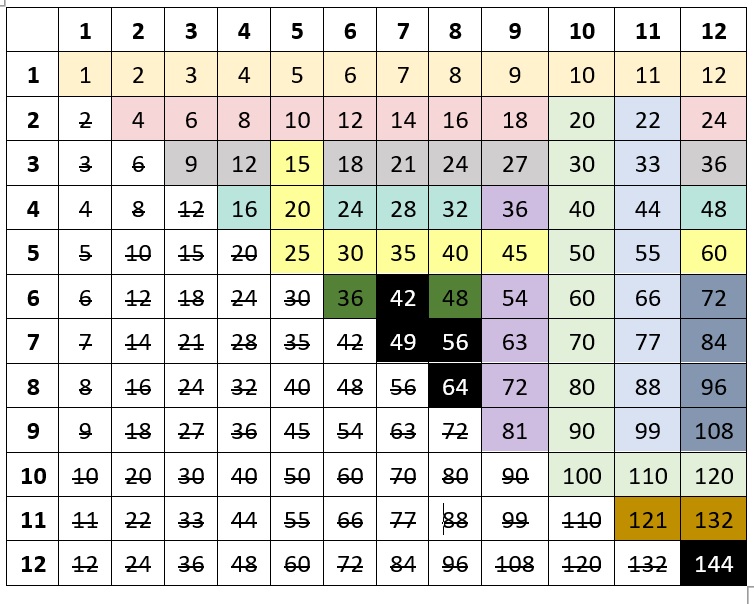
If you have a multiplication chart, it looks like you have 144 squares to memorize. That sounds hard.
Let’s make it easier: 66 are duplicates. Cross those out. That leaves 78 problems.
Then we can learn 11 rules. I’ve gone from the easiest rules the harder rules (roughly). The rules are color-coded based on the table above. /
- Orange: 1s. Identity rule
- Light green: 10s. Add a zero
- Light blue: Easy 11s. The digit twice
- Red: 2s. Double the number or skip-count by 2s.
- Yellow: 5s. Skip-count by 5s
- Gray: 3s. Skip-count by 3s
- Purple: 9s. There is a finger shortcut OR digit minus 1 and both digits added together equal 9.
- Aqua: 4s. Double the number and then double that answer.
- Dark blue: 12s. Times by 10 and times by 2 and add the answers together.
- Gold: Hard 11s. When you have any two-digit number times 11, you can put the first digit in the number in the hundreds place. Put the last digit of the number in the ones place. Add the digits together and that’s the tens place.
- Dark green: When you have 6 times a single-digit even number (2,4,6,8), the answer is that number divided in half for the tens digit and the number itself for the ones digit.
Then you have to memorize the black ones. That is only 5 problems.
We took 144 things to memorize and turned it into 16 things to remember. Sounds easier to me.
-
Subscribe
Subscribed
Already have a WordPress.com account? Log in now.
 Heather Hoyt