-
113. What keeps me from achieving my goals?
- Having the wrong goals
- Not having support from other people
- Not sharing my goals with other people
- Not being patient enough
- Laziness, because it’s easier to do nothing
- Knowing that even if I do everything I can, I can still fail
- Distractions, because it’s easier to consume than create
- Trying to impress people instead of trying to connect with people
- Emotional baggage and overthinking things
- Holding back and not going all in
-
112. What can I be grateful for?
It is tempting to be grateful for all the good things in your life. When life is going well, the projects are being completed, you are ahead of schedule, your kids are happy, and you’re living the life that you want, there is an easy list of so many things that are good.
But what if all that was taken away? What if there were deep and dark times? What is there to be grateful for?
Gratitude is not just a list of things that you like in your life. Gratitude can be a way of appreciating your very existence.
Are you grateful to breathe?
Are you grateful that you can think?
Are you grateful for your Savior, Jesus Christ?
Are you grateful for your experience of life?
If you are only grateful for the good things in life, you might find yourself unprepared, not resilient, easily fractured when those good things go away.
But if you can foster gratitude for your existence, for those things that will never leave you, then gratitude can become part of who you are, a strength when everything else goes dark.
-
111. Is deep work necessary?
Deep work sounds nice: being able to sit and focus and do difficult work over a longer period of time.
But that isn’t my life right now. And while deep work can be useful, humans really don’t work that way very often. Parenting, for example, is never deep work, and is one of the most important things we do.
We usually have lots of things going on in our life. Even in careers and jobs, people juggle multiple projects. I get bored if I just do one thing. I prefer switching focus.
I can sit and get really good and important work done in just a few minutes. If I’m worried about figuring out how to set aside hours at a time to work on something, then sometimes I keep procrastinating over and over again and I don’t do any work at all.
If I get too narrow-minded, I might miss opportunities that are in front of me. If I am always trying to focus, I might miss interruptions that are more important than my projects.
So I don’t think deep work is really necessary for life. There are good moments when you can focus and get into a good flow, but more often than not, my life feels like a constant distraction, and that’s okay.
(Thanks to my sister, Liz, because this was her idea.)
-
110. How do I wire in a light fixture?

First step to wiring: ensure that there is no electricity going to the wires you are working on. This may be done by switching off the breaker or by turning off the light switch (and making sure that no one is going to accidentally turn it on while you are wiring).
The basic idea to wiring is to match colors: black is the live wire. It sends current into the light. White is the neutral. It takes the electricity out and back to where it came from. And then the copper is the ground, which is for safety and makes sure nothing gets charged with electricity.
You might have to cut and strip wires, particularly if you are doing new construction. Wires are covered in a coating that is usually white or black, but the actual wire is the metal inside. The metal needs to be touching for the electricity to go through the different wires.
To attach wires together, you use wire nuts. You have to shove the wires in a twist the wire nut to twist the wires all together. The wires need to be securely in there, so it’s good to tug on them to make sure they are secure. You use electrical tape to secure the wire nut and wires in place.
And if you are using a metal box, you also need to attach the ground wires to a green screw on the box with a separate green wire (pigtail).
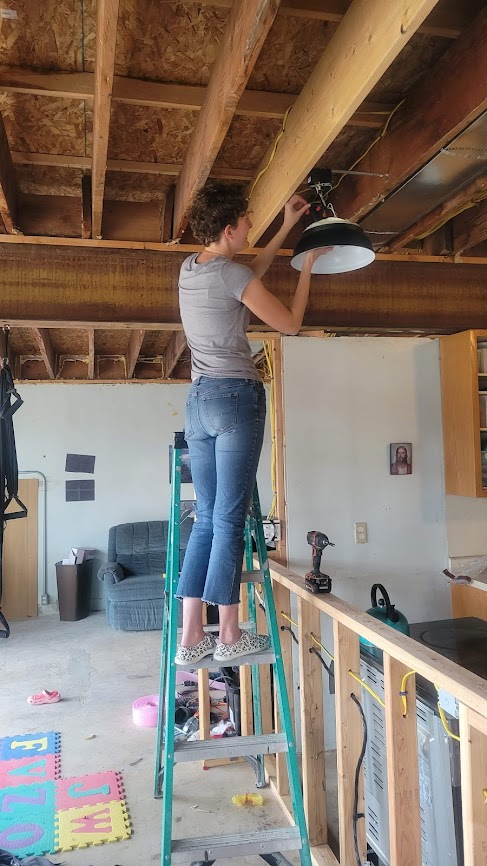
Usually you put on the mounting bracket before you attach the wires together. Then you put the wires together. When you’re doing a light fixture, you might want to find some extra help to hold up the light fixture while you are wiring the light. Otherwise, you have to pretend you have three hands.
After you put together the live wire, neutral wire, and ground wire, then you shove the wires back into the box, which isn’t a fun part of the job.
Then you attach the light to the mounting bracket and you’re done. You’ve installed a light.
Things that can go wrong:
- If you don’t adequately secure the wires together, then the light fixture may not work at all.
- If you attach the wrong colors, you might get sparks and start a fire.
- If you accidentally turn on power to wires you are working on, you can get electrocuted, which hurts.
I installed a few light fixtures yesterday, and to be honest, it was not easy. I didn’t always attach the wires together securely enough and had to do it again and again until I finally managed it. I had a hard time figuring out how to hold up the light fixture and wire it together. And shoving the wires back into the box can be hard, because sometimes the wires don’t bend like you want them to.
I would suggest that when you are learning to wire a light, you have someone who knows about wiring to come and help you out. While you can read or look at a tutorial, like this one, it can be a frustrating process to do the first few times if you aren’t sure what you are doing.
But once you attempt it a few times, it is a total doable DIY project.
Well, everything is a DIY project if you take the time and effort to learn enough.
-
109. What is easy in your life right now?
I am most often focused on what is hard for me. I have a lot of stress and worry and things feel hard.
But until this evening, I’ve never asked myself what is easy for me right now.
And the list was encouraging, since some things I had struggled with are no longer a problem. And I remembered that I am actually good at some things.
What is easy for me?
- Reading my scriptures every day.
- Knowing that my kids are more important.
- I have a good plan for the future.
- I feel pretty settled about who I am.
- I feel good with my faith right now.
- Blogging every day is easy.
- I’ve been doing well working on my house consistently with my husband.
- Designing and planning my house.
- I can type 100 WPM and do algebra really easily.
We take what is easy for us and immediately dismiss it, as if it’s insignificant. But a lot of people struggle with those things. A lot of times we have struggled with those things in the past.
So don’t discount what is easy for you. Recognize everything you’ve learned and the good choices you make. Stop thinking that everything in life is hard, because it isn’t.
And the easy parts can make the hard parts more possible.
-
108. How do you prepare for old age?
I’ve been reading some books and fell into some conversations about elder care. Getting old (and caring for the elderly) can be really hard, and very often, people don’t think about it and prepare for it.
But you will someday die, and probably get old, and people around you will die and get old and you have may to take care of them. And it’s so much easier to figure it out before it’s absolutely necessary to have it figured out–or it becomes too late.
I’m not any sort of authority on the subject, so I welcome any conversation, but these are the things I’ve noticed.
Prepare Financially
About everyone needs some sort of estate plan and planning about where the assets go when you die.
And getting old can be really expensive. So having a good amount of savings, pensions, retirement funds, insurance, and more can lead to better options when you get older. Save more than you think you need.
(Alternatively, there may be problems with leaving behind a large inheritance. Just take the time to really think about different situations, how you want to pay for it, and what you want to leave behind.)
This sort of preparing needs to happen at a very young age. You can start planning for retirement in your 20s.
Prepare Your Stuff
You should sort through your stuff and dispose of most of it once you are no longer using it. You should also have things digitized and organized so that other people don’t have to go through your stuff for you.
And leave behind a good record of yourself for your family: even just a basic life overview is really helpful.
Prepare Your Body and Mind
Take care of yourself. Exercise and eat right and go to annual doctor visits and floss your teeth. Keep up hobbies and improve your mind.
And also figure out what a good death might look like for you. Do your living will/healthcare directive. Do you want your life prolonged endlessly? What would you like your funeral to look like?
Prepare for Self-Reliance
Where do you want to live when you get older? How will that affect those who will care for you (which will probably be your children)? How can you make their lives better?
Chances are, when you get older, you won’t want to live in a single family home with a large yard because you won’t be able to take care of it by yourself anymore. Where do you want to be when you can no longer drive or take care of yourself or think clearly?
You might look into retirement homes or assisted living centers, and if you prepare financially, then you will be able to find homes that you really like that help keep you independent, prevent loneliness, and help your children take better care of you.
Prepare Now
Some of these things might be unpleasant for some people, but it’s good to try to figure out aging and death decades before, so you can adequately be prepared to have a good life and a good death.
Anyway. I feel a little silly writing about this because I’m in my 30s, but this subjects needs to be part of our conversations much more often. It can be a really hard part of life, but avoiding talking and thinking about it just makes it harder.
-
107. What is your favorite Thanksgiving food?

Did you know Thanksgiving will be in a week after tomorrow?
My oldest son doesn’t really like anything about Thanksgiving. He endures it. My youngest son loves mashed potatoes, and so he loves Thanksgiving.
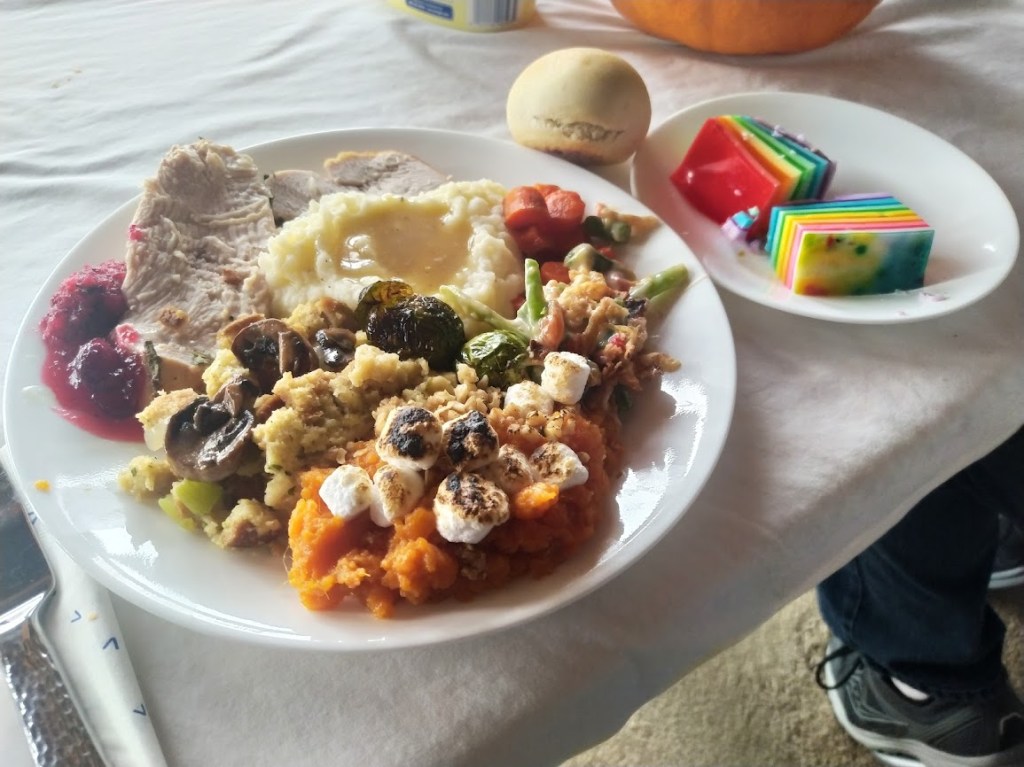
I pretty much love Thanksgiving food. I like turkey and cranberries, rolls and mashed potatoes, stuffing and sweet potatoes. I like pies and whipped cream and even green beans and carrots.
I am fine with the boxed and canned and cheap versions of everything. I don’t need it to be homemade and fancy, and sometimes it sort of ruins the dish when it is trying to be something different.
Oh, and I really do like Jell-O.
Growing up, my mom came up with a rainbow Jell-O recipe, which consists of 12 layers, in rainbow order, of Jell-O. It happened every year, and Thanksgiving just isn’t the same without it. Rainbow Jell-O is Thanksgiving for our family.
Well, we all got older and married and went to to other family’s Thanksgiving celebrations, and now instead of sharing a large pan of rainbow Jell-O with each other, we often make our own and bringing it to lots of different celebrations.
This year, I’ve found all my colors, and I’m traveling, and very much hoping that my Jell-O can endure some time in the cooler and uncertain if there will be space in a fridge for it. But I’m going to try.
When I make my own Thanksgiving, the food is exactly how I like it. And then there are other years when the turkey is really overcooked, or the stuffing is rice pilaf instead of stuffing, or there aren’t enough mashed potatoes, or the sweet potatoes don’t have enough sugar, or dinner is two hours late and eaten on my lap on the front porch with a plastic fork.
But I can just remember that I can come home, and cook my own meal, even pour some more rainbow Jell-O. Thanksgiving is about the food, but the people who make it are more important.
-
106. How do I learn statistics?
I took statistics for the first time just a few years ago, and it seemed quite difficult. There weren’t right answers; there were confidence intervals. Equations had to be memorized and I didn’t understand why they worked. And instead of just math, there was lots of information like designing experiments and what sort of data is better than other sorts.
But the class was designed quite well, and I got through it. Then I took econometrics (which is statistics for economics), which turned out to be more of a coding class, since there is no reason to do statistics by hand if you can have a computer program figure it all out for you.
Statistics is the backbone of science, really. (And whether or not that is a good thing is debatable.) It’s not entirely useful for everyday living, except to understand what scientists are doing. It is necessary to learn and understand if a person wants to complete graduate-level projects.
I think one of the better ways of learning statistics is to learn about basic concepts and how they are useful (confidence intervals and P values and statistical significance). Then, you learn how to code (using R or similar), in order to avoid doing the math.
But then the only way to really learn statistics is to do statistics: to have a data set and to want conclusions from that data set, and then to figure out how to wrangle those numbers.
It’s a tiny bit like you can’t really learn how to parent until you are parenting. And you can’t really learn how to do statistics until you are doing statistics.
-
105. What was your favorite toy growing up?

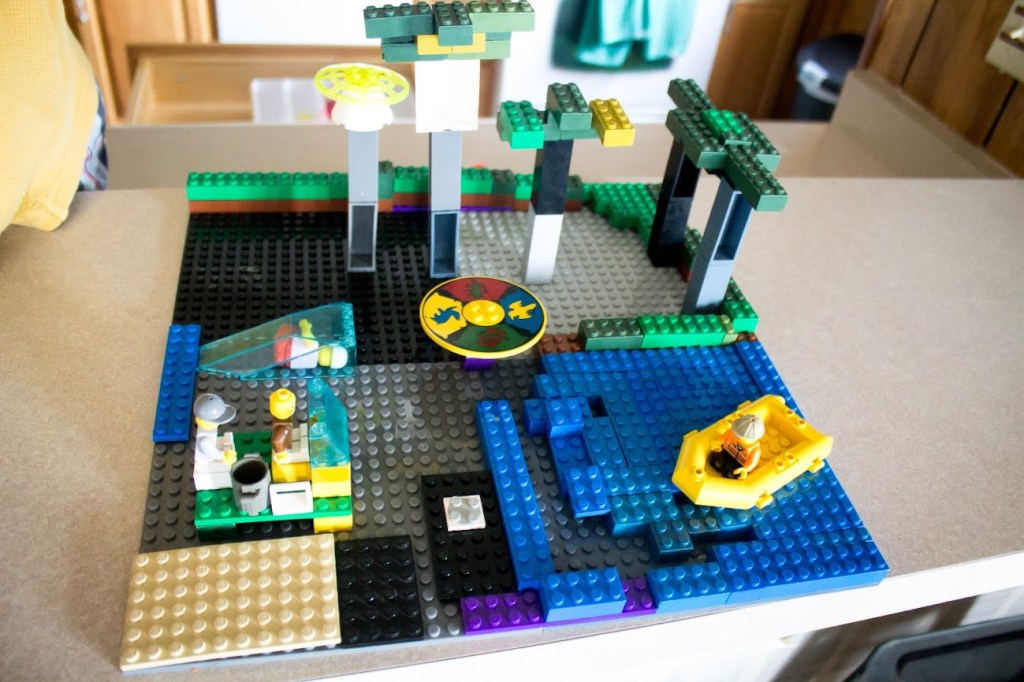
My kids love Legos, tape, paper, boxes, Barbies, Pokemon cards, toy kitchen stuff, random building stuff, and a few action figures. They play boards and card games and jump on the trampoline.
Growing up, I mostly remember playing with stuffed animals and in the playhouse in the backyard. Lots of pretending. I collected teddy bears and my twin sister collected cats. My older sister collected koalas/Popples, my older brother liked chipmunks, my younger sister still has a large panda collection, and one of my younger brothers collected tigers. The other younger brother like Barney and dinosaurs.
So it was a thing in our household. My kids don’t quite get as attached and interested in stuffed animals. But they do have Barbies, and I wasn’t really allowed to have Barbies growing up. My mom didn’t like them being naked, which is fair, because almost all the Barbies I now own have built-in clothing.
I am surprised though that I didn’t play with Legos more when I was young. My brothers played with Legos, but I didn’t get interested in them until I was an adult. I only really like Legos when I’m following the directions and building exactly what I’m supposed to. So I can’t really touch them, since my kids just always make a mess of things.
What are your favorite toys?
-
104. When do we need faith?

To this extent, it is quite correct to say that belief or faith is the element of all certainty
Johann Gottlieb Fichte, On the Basis of Our Belief in a Divine Governance of the WorldWe need faith for everything, and we use it a lot more often than we realize.
If faith is believing without really knowing, then we put faith in all sorts of things.
How often have you read something or heard something for a friend and accepted it without thought? Why are you so certain of the knowledge you have?
Certainty is based in some degree of faith, in taking a leap and hoping that we’re right.
-
Subscribe
Subscribed
Already have a WordPress.com account? Log in now.
 Heather Hoyt