This is hard

I’m writing a dissertation for the first time in my life, and it’s harder than expected. Not that I expected it would be easy. I am making progress, but it feels like it is often a few steps forward and a few steps backward. Instead of going straightforward in a line, I am winding myself through a maze with quite a few inevitable dead-ends.

Sometimes I write thousands of words and then immediately think how I am going to reframe the whole thing. And often, despite working on a chapter for weeks, I don’t have much to show for it at all, but I know I’ve been working, and I know that the work was necessary. Sometimes you don’t know where to go until you’ve explored around a bit.

But I’ve also felt terrified of my dissertation. I wondered at that, because I’ve written book-length projects before, and I’ve written academic papers, and there is nothing about this dissertation that I haven’t really done before. Except for one thing: I have a committee who will read this. I’ve never had a committee before, and they are made up of exceptionally talented people who are all more intelligent than I am. It’s intimidating, even though I know that they are there to help me.

I have written over 20,000 words on my dissertation, but I do believe I will rewrite and redo almost all of that, so it’s as if I’ve written nothing. And yet, the next 20,000 words will be a whole lot easier because of that foundation I have.

I think one conclusion is that when things take longer than you expect, it’s not necessarily your fault. Maybe you are doing something wrong, and maybe there are quicker ways of doing it, but you learn a lot from going the wrong way for a while. You build yourself up by making mistakes. Projects are not straightforward, and in the turns and curves and backtracks, they become much richer and more interesting.

Tearing Down and Building Up

A professor in one of my classes told us that a philosophy paper gets lots of other people citing it when it is an easy target. Papers get cited not because they are good and authoritative, but because they are flawed, and then they get torn apart.

I have experienced this often in school: We read a paper. Not many people had nice things to say about the paper: It was quite faulty and not written perfectly. There are problems with the argument and examples and structure. The author cites too much or not enough.

In philosophy, unlike Theodore Roosevelt’s quote, maybe it is the critic who counts. I really like criticizing things sometimes. It feels powerful and fun. Like I’m better than someone else.

Sometimes I look on Reddit and comments on news articles and I am amazed at the loudness of all the critics who simply think that they are right and other people are wrong, so that entitles them to be mean and say whatever they want.

But I don’t like always tearing things down. I want to stop tearing things down. Start building something up instead.

Remember “constructive criticism”? When we criticize, we shouldn’t be doing it with the sole agenda of destruction. We should be building something up–making something better, working on improvement, or coming up with an alternative.

And if you want to destroy without building something up afterwards, then maybe it’s not worth it to tear that thing down. Maybe it’s best just to move on. So if it’s a really bad article, don’t read it or discuss it. If someone does something you don’t agree with, don’t pass judgment and complain about it with someone else.

Try to find good. Try to construct truth. Try to connect.

Changes

School starts tomorrow for most of my kids. I need to go fold laundry so that they can find what they want to wear, though I think they may have sorted through the laundry already.

This doesn’t feel that different: we just fall back into the old routine that we had a few months ago. I wake up at 6:30, get my daughter on the bus, come back and get the other kids ready.

But then something new happens. I’m going to school too now.

I am excited about it. I’m excited to connect with other people. To have time where I can exist outside of my home and my kids, and to be able to grow and learn, and then come home and share a bit with my children. They probably won’t ever care. My daughter said that all my books were boring and were about algebra or something. Philosophy isn’t math, and she sort of knows that, but she just categorizes everything she considers hard and boring together.

My daughter isn’t like me in some ways. She’s outgoing; I was very shy. She love cartwheels and handstands; I could never do one in my life. But we both love reading, even though she likes more adventuresome books than I do. I love watching her simply be herself.

I will come home every night after school to my somewhat unfinished home, to my children and my husband. I’ve never come home before like that. I’ve always just been home. And I think I’ll like coming home.

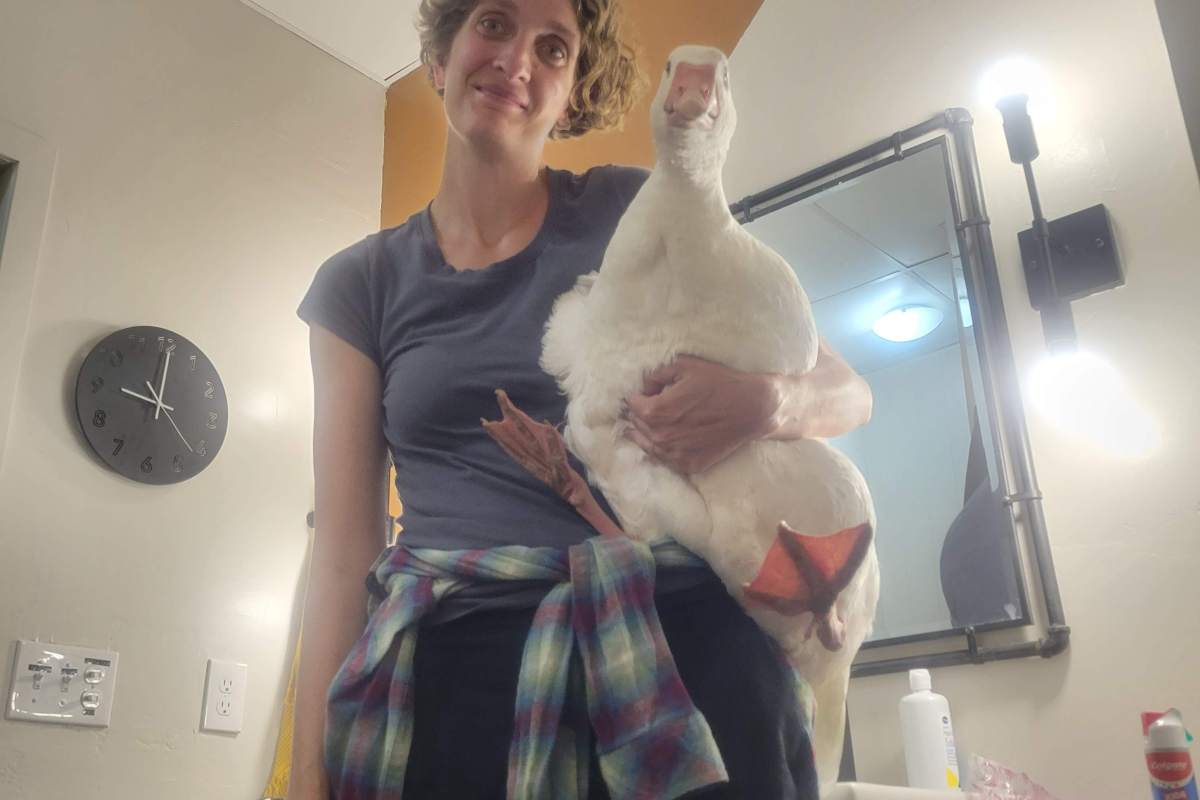
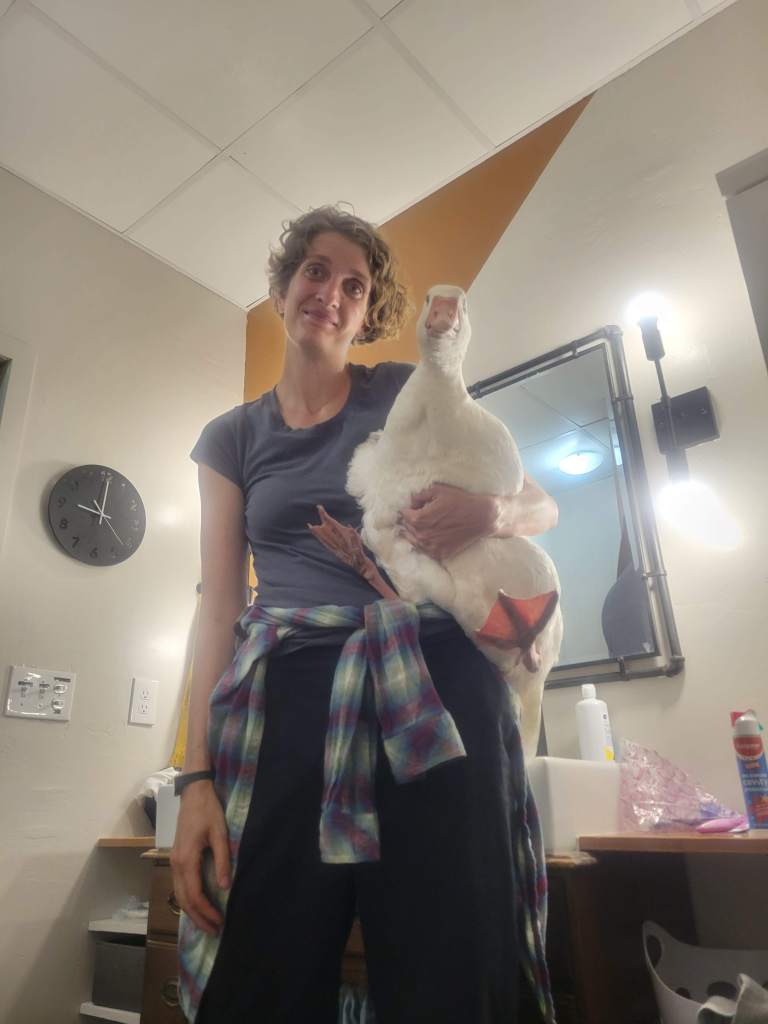
Also, I am including an interesting picture. It is of me holding a goose in a bathroom. I was on my computer in the evening and I looked up to see a goose staring back at me. We have a magnetic screen door, and Amelia figured out how to get inside. I had to pick her up and take her back out and shut the door, but she and Abigail still really wanted to come back in. The duck was in the pond, quacking and being sensible.