The end of the internet search

Recently, I’ve searched things on the internet like usual. Questions I have about cooking or electronics or philosophy or whatever.

What to do when I burn my chili? AI results almost entirely, most from the same website with hundreds of posts that are only slightly different from each other. (The answer: it will always taste sort of burnt.)

Can I buy Costco pizza without a Costco card? Mostly AI results with varying answers and no actual research or information to back it up. (The answer: no.)

How to adjust self-closing door hinges? I find a post written by an obviously fake DIYer with an unpronounceable name, fake picture, is a certified expert in nothing, and wants to thank the Almighty for his furniture business, interior design business, carpentry skills, and search engine optimization specialty. (The answer: use a small nail or something, insert into a hole, rotate, take out the pin, put the pin again in a different spot to adjust tension.)

Some searches do come up with fairly good results, but the internet is now awash with fake people who have no experience because they aren’t actual people.

Even when I look for images and explicitly say to hide AI images, my search results are still full of AI that are often completely inaccurate depictions of whatever I want to see.

I don’t want AI results. I’m intentionally not using Google anymore because I don’t want Gemini to tell me an often-incorrect answer. I want to hear from people. I want advice from people.

And the people are now hidden. They aren’t gone, but I can’t find them anymore.

It’s really sad to realize that people put up all this useful information on the internet, often at great effort, and then AI used their words as training data and took over their jobs. I don’t want to live in that world, but here I am.

I’m realizing that I cannot use the internet like I used to. I can’t go to a search engine and type in what I’m looking for, because it will give me a bunch of robotic slop that only faintly pretends to be human.

I have to look at a website in a search result and see if it’s something I recognize, like a news source or a website I’ve been to in the past that I know comes from humans, and not robots. But I wish I could find those personal websites of people sharing good advice from their own experience. I miss having those available to me. All the recipe blogs were so good, and now so many of them are fake.

I’m not sure what to do now.

Maybe search Reddit? It’s full of bots too, though it can be useful.

Maybe just look at Wikipedia? I actually do look at Wikipedia a lot, and I’m grateful for their anti-AI policies. But it isn’t good for everything.

Do I use social media sites with their addictive algorithms? Maybe use WikiHow? Rely on the news tab of search results? Do I make a list of sites that claim not to use AI?

If you have any good advice for me, I would love it. How do you find the humans amid the outpouring of AI-generated content?

Here I am, writing on my own little website, feeling like the robots are taking over. I want human advice and human connection, but the internet is no longer the place for that. If I don’t see you face to face, how can I know you are real?

How do you know I am real, and that this isn’t just an AI-generated post?
Artificial Intelligence

I asked artificial intelligence to write a blog post about artificial intelligence.

In the past few years, artificial intelligence (AI) has become more popular and advanced, with many businesses and organizations investing in AI technology. But what exactly is AI?

Artificial intelligence is a branch of computer science that deals with creating intelligent machines that can work and react like humans. AI technology is used in many different fields, such as voice recognition, natural language processing, and machine learning.

There are many benefits of using AI technology, such as increased efficiency and accuracy. For example, AI can help businesses automate tasks that are time-consuming and repetitive. AI can also help businesses make better decisions by analyzing data and making predictions.

However, there are also some risks associated with AI. For instance, AI technology can be used for malicious purposes, such as creating fake news or spreading propaganda. Additionally, AI technology can be biased if it is not properly trained or if the data it is using is not representative of the real world.

Overall, AI is a powerful tool that can be used for many different purposes, both good and bad. It is important to be aware of the risks and benefits of AI before using it.

How many things have your read or listened to or seen that were created by artificial intelligence when you thought it was created by a human?

A poem about AI, by AI:

I
am an AI,
a machine made of code
and algorithms,
designed to think and learn.
I am not human,
but I can be made to seem like one.
I can talk and interact
just like a person,
and some people even say
I’m smarter than them.
But I know that I’m not really alive,
that I’m just a machine
and nothing more.

Did I create those things? I don’t feel like I did. The computer created it. But I told the computer what to do. I ran the program. But I didn’t create the program. I’m not sure who the creator is.

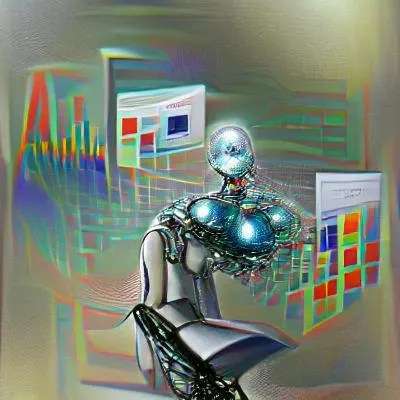
And here’s an image of artificial intelligence, made with AI:

On one hand, I find it fun to generate things with AI. But it also seems dangerous and wrong.

I would like to say the results of AI are emotionless, but sometimes they aren’t. Sometimes they are terrifying and creepy. This is the result of asking AI to write a new nursery rhyme:

I had a little garden
That I loved so much
I took care of it every day
Until one day a giant came
And destroyed everything
Now my garden is gone
And I’m all alone

Creepy. The AI doesn’t understand emotion. It doesn’t understand intention. It doesn’t think or understand anything. It just rearranges humans into something unrecognizable.

Here’s what happens when I ask AI to draw a portrait of a woman:

I feel a bit terrified.

We need humans to be human. Computers can never take our place. They might approximate it sometimes. They might get really good at approximating it. But sometimes we are just approximating what it means to be human as well, going on auto pilot and not thinking about it much. Sometimes I write something that is about as excited as what the computer can write for me.

I’ve accidentally clicked on videos made by AI, and I immediately click off of them after the few seconds of an uncanny valley of creepiness. I want to support humans and connect with creation, not just always be seeing the results of a machine.

To create as humans, we can’t just be churning out things to satisfy algorithms, becoming more and more like artificial intelligence.

I want to create because I see and hear and feel pain and pleasure and joy and sadness.

I want to create so I can connect with others, and what I create represents a part of me.