Mental Health Day = Show Up Anyway

I have heard sometimes that people take a mental health day and they miss school/work/etc. in order to take care of their mental health. I am skeptical. I think often the best thing we can do for our mental health is to show up, especially when we don’t feel like it.

Recently, I was feeling very stressed and overwhelmed. But I felt stressed and overwhelmed when I was at home, not getting the schoolwork done. Going to school and working helped reduce my stress. Being around other people in a similar situation actually helped my negativity to dissipate. Talking to others helped more with my mental health than staying home would have.

I know when I am feeling down and depressed, I do want to stay home. I very much want to not show up, and just take some time off. But the great majority of times when I show up, even when I don’t want to, I feel better. I’m glad I went.

Chronic absenteeism is a huge problem in schools right now. Students aren’t showing up. And part of this problem might possibly be that people think they need to feel good to show up. And if they feel bad, they stay home. But just makes them feel worse. And so they stay home more.

Now, there might be some situations when people need breaks. Breaks are good and healthy. However, I have found in my own situation that the structure of showing up regularly does much more good for my mental health than breaks ever do. Breaks are better when they scheduled and intentional, not just randomly missing because you don’t feel like going.

So if you don’t feel like going to school and work, do it anyway. Show up for yourself.
Narrative Motivation

I recently read Narrative Economics by Robert J. Shiller, a Nobel Prize-winning economist. In that book, he talks abut how viral narratives can change people’s behavior–which changes the markets and economy. He suggests that economists should really be paying more attention to common narratives.

I’ve also been researching and thinking about motivation lately. In Drive by Daniel H. Pink, there are three types of motivation: Type 1 is getting what you need (you cold think of Maslow’s hierarchy of needs, or just that when you feel hungry, you want to eat). Type 2 is incentives, or rewards and punishments. Type 3 is intrinsic motivation, which is basically doing things that we just like to do, and working towards flow and mastery.

But that seems incomplete. For example, suppose that I clean my home well right before I go on vacation. I’m not doing it because I need anything. I’m not doing it because of some sort of reward–I’m going to be gone, so I don’t get to enjoy the clean home. I’m not doing it because I am intrinsically motivated to clean, as I don’t like cleaning. So why do I clean my home?

Because I believe in a simple narrative that I learned growing up: you leave your home clean. I saw my mom clean our house before vacation. So I do the same things. That’s just what you do.

I think a lot of what we do is not about what we need (a lot of those needs are already met), and not about incentives (while there are natural consequences to our actions, we do a lot of things without considering consequences), and not about intrinsic motivation (because I am constantly doing things I don’t really like to do). We do things because we believe narratives. Narratives like:

  • Parents play with their children.
  • Moms are in charge of keeping the house clean.
  • Grass is green.
  • Good people help others.
  • Every meal needs a protein, grain, and vegetable.
  • People in my family get good grades.
  • Successful adults buy houses.
  • To do lists need to get done.

These aren’t long stories, but short things that we’ve picked up from society. We’ve learned from parents, friends, family, neighbors, communities, social media, articles, books, movies, TV, etc., etc. We are all building the stories of our lives from these short narratives about what is normal or what you should do actually direct a lot of our behavior.

We can’t always change the narratives we believe in. But we can change what we pay attention to. We can build our values. We can spend time with different people. We can have transformative experiences. And all those experiences build our story, and the narrative that we believe in.

What are your narratives that motivate you?

Also: this idea is new and I think it might be a good idea, but I’m still working on developing it! Please share all your thoughts you have: questions, confusions, disagreements, agreement, etc.

The Right Time

In 2018, I put a book I had written (One Thing is Needful) in a figurative drawer and thought I would never look at again. But in 2020, I got it out again and started working on it. Two years later, I’ve basically finished it. I’m working on sharing it more soon.

I try to follow the Lord’s will about when to do things. Sometimes I do the right thing, but it’s not the right time yet. Sometimes it takes me a whole lot longer than I want it to.

In the end of 2018, I moved to this home in the mountains and I thought I would live here for forever. But I didn’t stay more than a few months, and when I moved away, I thought I would never come back. A year later, at the end of 2019, we owned this house and it’s been my home for almost two years now.

I really worked to get a novel published before I had kids, but it didn’t work out. I thought I wasn’t good enough to be a writer and that I failed. But years later, I went to a conference, surrounded by authors and people trying to write, and I realized that I didn’t fail because I wasn’t good enough. I failed because it wasn’t the right time for me yet, and I had more things to learn.

The right people will be in your life at the right time. I have felt very much alone and I thought no one was there–but those times forced me to reach out to people who needed me. And then people came when I needed them to. I was led to people who I needed to connect with. I learned from others when I needed to learn those things.

I still don’t know the timetable for many things in my life. Some things will be a lot slower than I want them to be. Some things might happen a lot quicker.

But if I trust in the Lord, I can do His will.

And His will is much more about becoming the person I need to be than just getting things done.

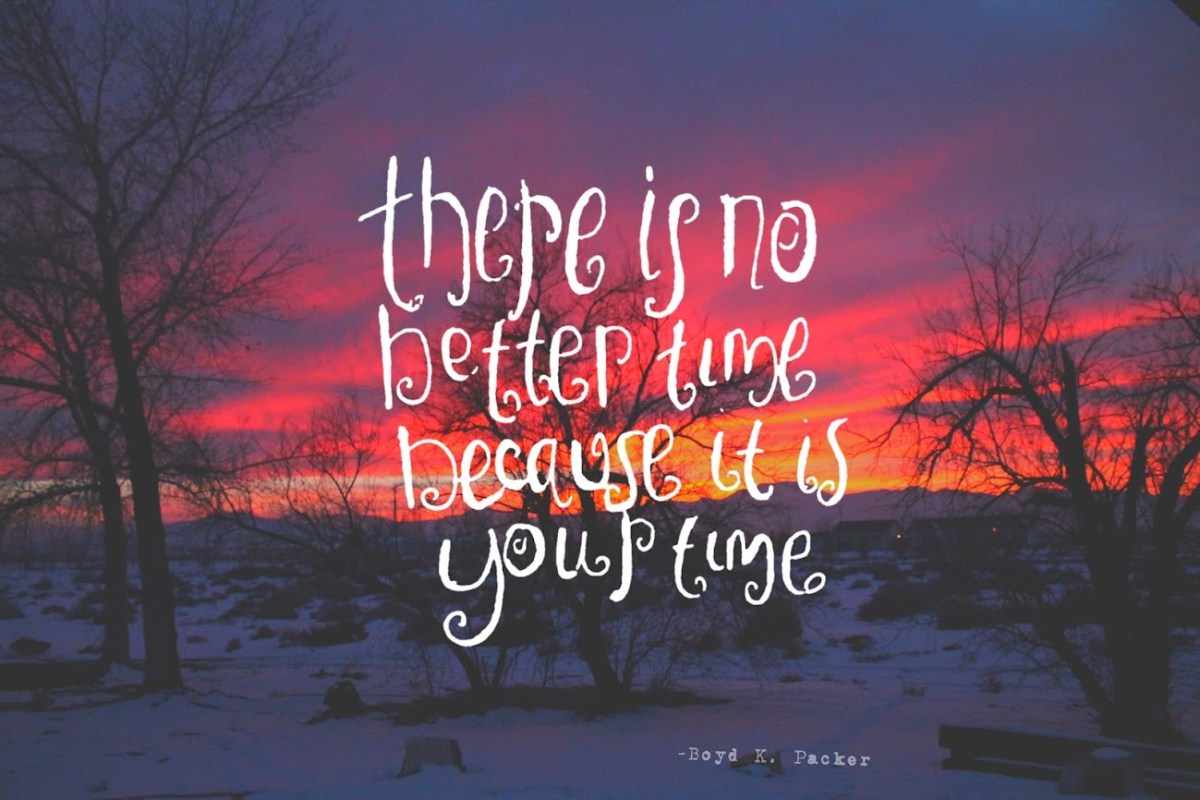
There is no better time because it is your time. -Boyd K. Packer

6 Ways to Get Things Done

I have a lot to do right now.

Some people have asked me how I do everything–I don’t think my list of accomplishments is overly impressive or unachievable. I’m mainly a stay-at-home mom, but I also have a lot of things I do on the side. I write books, I blog, I take photographs, I read books, and I try to keep learning. Here is how I do it–and how you can probably achieve a whole lot more than I do.

1. Set goals.

This is the first place to start. You won’t achieve much of anything unless you set it as a goal. Wanting to do something is not enough–it will always remains a wish. A goal must be specific and it must have a deadline. Examples: I will write a rough draft of a book this year.

2. Make a timeline.

After you have a general deadline, you break up the goal into smaller tasks. For example: I will write a 10-page chapter every week. I will write two pages five days a week.

3. Schedule out the day.

I did a lot during nap time when my kids actually took naps. Quiet time can also be helpful–quiet time is when you tell your kids to quietly entertain themselves for a while. Also, sometimes my kids really like playing with each other and I’m not needed. And they go to bed early, so the evening provides some more time for me to work on things.

When you plan out your day, you are much more likely to accomplish the tasks that help you complete your goals.

4. Focus efforts.

Sometimes my kids get ignored for a minute. Sometimes dinner is late and not very fancy. Sometimes the dishes wait. No one can do it all and everyone has to learn to make sacrifices in the right places. If you need more time, try sacrificing social media, reading the news, or watching television.

5. Allow for wiggle room when things don’t go according to plan.

When I wrote a novel in a month last year, I had a goal to write 2,000 words a day instead of the suggested 1,667–because I knew I needed some wiggle room and some space where I could breathe and have a bad day. I probably should have increased it to 2,500 words a day (or just written a novel in two months), because I still got very behind. We all have really good days and really bad days. Don’t get discouraged when you fall behind–it’s better to try and not quite get it done than to not try it all.

6. Believe in yourself.

You can do more than you think you can. You might already be doing more than you realize–and instead of feeling overwhelmed about life and your circumstances, you can be proud of your strength and your efforts. If something is hard, you continue forward with the understanding that you are learning and growing. You can believe that you can accomplish your goals, and you will keep working towards them.

You are the only type of superhero this world has: ordinary people doing one small task at a time. All those small things combine to make something amazing.

OLYMPUS DIGITAL CAMERA