20. How do I create a mood board?

My favorite way to make mood boards is in Sketchbook.

This is about how Sketchbook will look when you open it for the first time.
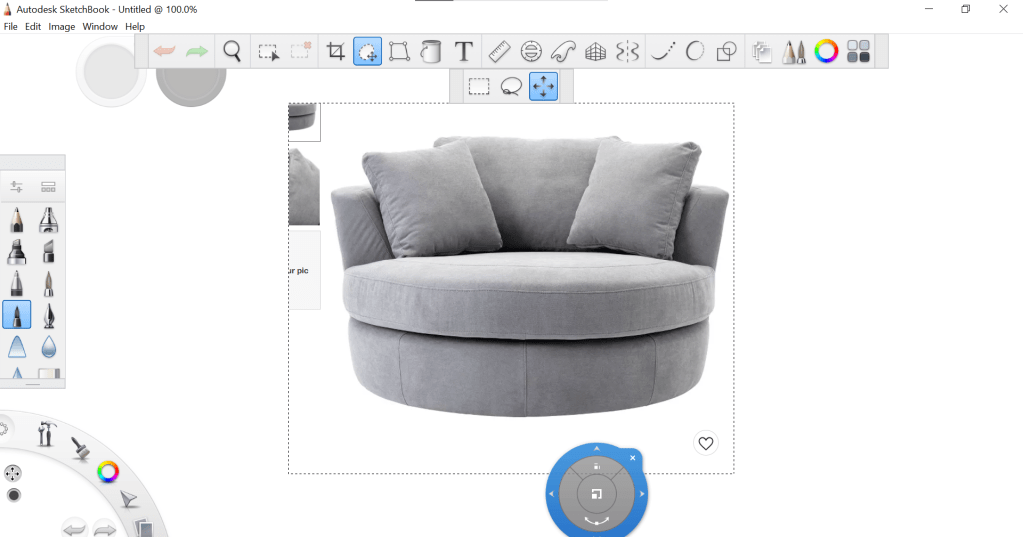
The first step is to import an image. You can do this by a copying an image from the internet or using the Print Screen feature on your computer.
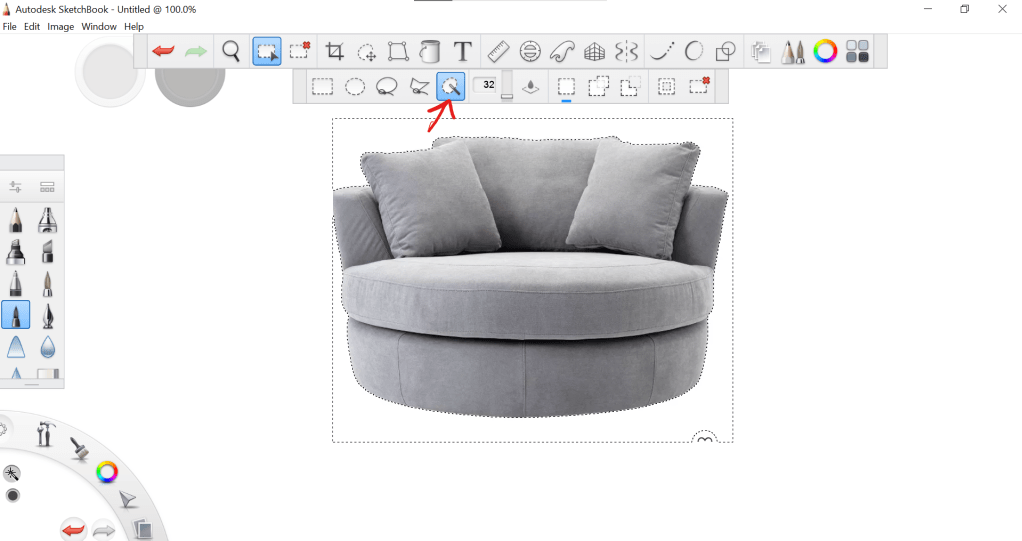
You can use the magic wand select tool to select all the white space from your image. You’re going to then invert your selection (it’s in the same select toolbar, the button second from the right with a dashed square nested in another dashed square), and then just type Delete and all that white around the piece of furniture will go away so you can layer it with other things.
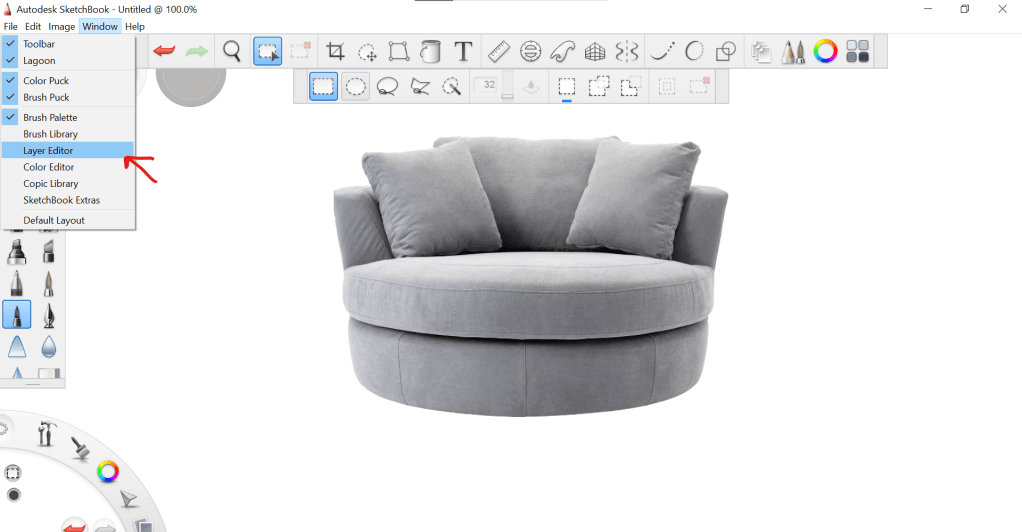
You need to show the Layer Editor Window, and you can do that by going to Window -> Layer Editor.
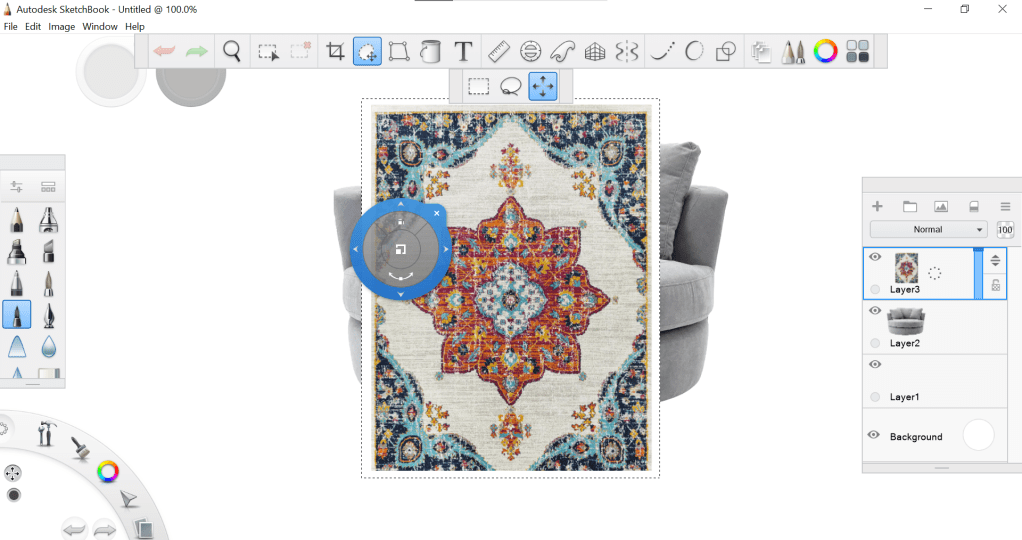
I copied in another image. When I copy it, it automatically creates a new layer. In the Layer Editor, I can rearrange the layers so that the rug goes behind the chair, instead of on top of it (I use the little button with the arrows up and down).

Do you see that circle thing on top of the chair? That’s the Quick Transform tool, and you can get to it by clicking on the button that is highlighted in blue in the toolbar. The middle of the Quick Transform tool can be used to resize. Going outward, you can rotate, and at the edge, move an object around.

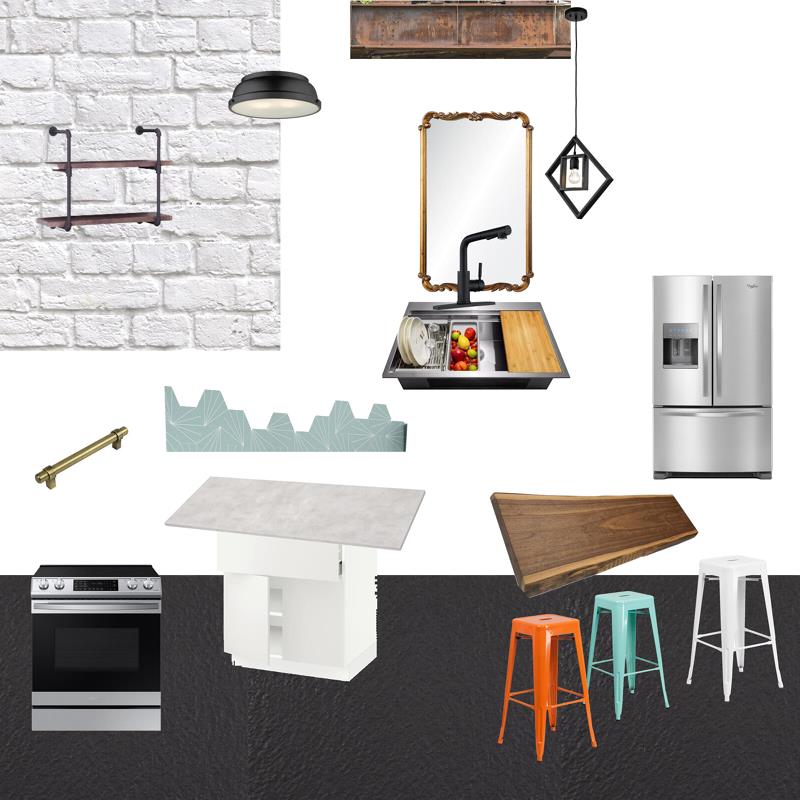
As you add more layers, you eventually create a mood board. You’ll want to save it as a TIFF file to be able to come back and edit the layers. But if you want to share, you’ll have to save it as a jpeg or a png and flatten the images. Here are some mood boards I’ve created for my house:
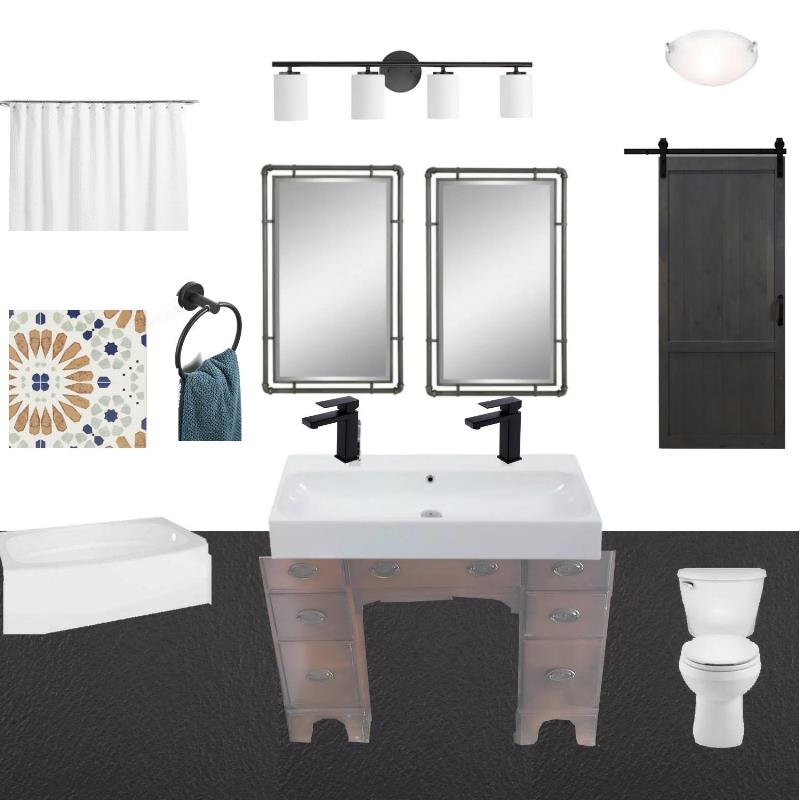
They aren’t perfect, but they still help me visualize my space as I work on selecting finishes.

19. Is it okay to give up?

Yes. Because a lot of the things we pursue don’t really matter that much after all.

I don’t give up on family; I don’t give up on people. I don’t give up on myself becoming the best version that I can be.

But I start a lot of projects, and I’ve quit and given up on lots of them and it was for the best.

In ninth grade, I sat on the bench of the ninth grade team. I didn’t quit that team because I wasn’t supposed to quit–but sometimes I wonder if it would have been better if I had just walked out and done something better with my time. I never played on a basketball team after that bad experience, but that worked out really well for me, as the girl’s basketball team in my high school was plagued with drama and problems.

There are the wrong reasons to quit, like being afraid or being lazy. But there are good reasons to let go of something: sometimes dreams are impossible or messy or ugly, and we need to protect ourselves and the ones we love.

When we start something, we don’t always know what’s going to happen, and when we find out more information or things go wrong, it can be good to get to a better place.

18. What is the optimal time to go to bed and wake up?

cease to sleep longer than is needful; retire to thy bed early, that ye may not be weary; arise early, that your bodies and your minds may be invigorated.

Doctrine & Covenants 88:124

Sleep schedules will vary from person to person and not everyone needs the same amount of sleep at the same time.

But it is best to have a consistent sleep schedule. Our bodies are also wired to go to sleep when it’s dark outside and to be awake when it’s light.

And adults need 7-9 hours a night.

For me personally, I don’t like staying up any later than 11:00, and usually I’m wasting time if I’m staying up past 10:00 or 10:30. I can’t consistently wake up earlier than 6:00 in the morning.

I know I need at least 7.5 hours of sleep to function, but I don’t need anymore than 8.5 hours. So I should at least go to sleep between 9:30 and 11:00 and wake up between 6 and 6:30. Optimally, I would go to sleep more towards 9:30 or 10:00 than 11:00.

17. What are good ways to solve the world’s problems?

The Government Organization

How did we put a man on the moon? We created a government organization that employed extremely talented people that worked together in teams solving small problem after small problem until they figured out how to do it.

The Open-Source Crowd

How did we get a general, somewhat reliable source of information about just about anything on the internet? Someone decided that if there was an open encyclopedia that anyone could edit, eventually there would be quality articles written by professionals and experts. And so Wikipedia exists, and while it’s not reliable, it is still about the best place to go for background information on just about any topic. Writers and editors don’t get paid; people just put their heads together try to create something accurate and useful.

The Academics

How do we figure out how to execute monetary policy? There were a bunch of intellectual people who started to think and publish papers and books and in all that discussion, came up with some macroeconomic models that are used to determine how to set interest rates and control money supply.

The Nonprofit

How do we make sure that everyone can eat? People created food banks that give out free food to people who need it. Backed by donations and supported by volunteers, food banks use the kindness of others in order to help.

The Corporation

How do we communicate better with each other? Tech companies, working for a profit, created and improved email, online chats, video conference social networks, and more.

There are lots of ways to solve problems, and one way is not necessarily better than another. It depends on the problem, and many different organizations and systems can work together in order to create a better world.

16. How do I make life easier?

  • Pace myself. Don’t try to do everything all at once. Limit myself on what I do in a day. Realize things may take longer than I realize.
  • Do what I enjoy doing. Sometimes instead of doing what I half to do, it’s okay to do something that I really want to do.
  • Create and follow routines.
  • Simplify. Can I do something in an easier way?
  • Remember why I am doing something.
  • Focus on relationships instead of getting stuff done.
  • Call it good enough. Very few things in life need to be perfect.
  • Be okay with being sort of bad at something. Sometimes a pathetic effort is all that is required.
  • Let go of things that don’t matter. I need to eliminate things regularly.
  • Ask for help and let others do their part. I don’t need to be solely responsible to clean my house, for example.
  • Make things fun.

12. What are good meals for camping?

I don’t really want to cook that much when I’m camping: all I want to bring is a camp stove, a skillet, and a small pot, and it better be ready in around 20 minutes or less. I more want to assemble things together and still have something nice to eat. The food also had to be able to be cooked if there is a fire ban and fires aren’t allowed, and it’s preferable to not use a cooler as much as possible.

  • Breakfast:
    • Pancakes
    • Scrambled eggs
    • French toast
    • Precooked sausage and bacon
    • Hash browns
    • Breakfast burritos
    • Instant oatmeal
    • Cereal
    • Bagels
  • Lunch:
    • Pack lunch meat, cheese, veggies, fruit, crackers, chips, bread, tortillas, peanut butter & jelly, etc., and then assemble them together in different ways to eat lunch. So you can have salad, sandwiches, wraps, lunchables, etc.
  • Dinner:
    • Hot dogs and beans
    • Asian chicken salad (cabbage, canned chicken, mandarin oranges, crunch noodles)
    • Nachos (with canned cheese sauce)
    • Chili and chips
    • Soup from a can (beef stew, whatever)
    • Tacos and taco salad (meat made ahead or just use canned chili)
    • Chili in a bag of chips with toppings
    • Spaghetti
    • Macaroni and cheese
    • Ramen noodles and frozen veggies (with eggs if you would like)
    • Tuna sandwiches/tuna salad
    • Pasta salad
    • Black bean salad
  • Dessert:
    • S’mores (cook marshmallow on stove if fire isn’t available)
    • Baked goods and snake cakes made in advance

What other ideas do you have?

11. Can there be more than one infinity?

Simple answer: yes.

This video basically describes how:

I’ve been diving a bit into infinity with this online class. Part of trying to understand this is realizing that I’ve held certain concepts in my head there were wrong.

I had this idea that infinity is the biggest you can get to. But that’s not really what infinity is. If I have an infinite amount of natural number (1,2,3,4,5 . . . ), I still have constraints of what that infinity means. There is an infinite amount of natural numbers, yes. But I’m still just dealing with natural numbers.

There are also an infinite amount of rational numbers (think fractions/decimals) between 0 and 1.

Some infinities are bigger than other infinities. You can compare infinities by doing a bijection of one set to another. If you can connect each entry in one set to a corresponding entry in another set and vice versa, then the sets are the same size. To prove whether infinities are the same or different size, you just have to create a rule or process to form a bijection.

If I have infinite rational numbers, then this is bigger than infinite natural numbers. I can count infinite natural numbers. But infinities do not have to be countable.

There is a diagonal proof that basically says this: try to write a list of all the rational numbers in decimal form. Now take the first digit of the first number and change that digit. Then take the second digit of the second number and change that. The third number, change the third digit. And if you keep changing the digits on for infinity, then the number you end up with will not be on your list. Thus, the rational numbers are not countable and are bigger than the set of natural numbers.

There are also an infinite amount of infinities that are larger and larger than another.

I had a concept of infinity that was incorrect. But it was useful to me, until I wanted to learn more and I had to change what I thought.