-
Jonah

Can I run away from the commands of the Lord? Can I flee when it is too hard? Board the ship, pay the fair, sail away.
But the Lord is there, in the wind on the sea, in the violence of the storm. Even when I sleep, the Lord is there.
I cannot awake and pray for deliverance without facing my own shame.
Throw me into the sea. The Lord found me on this boat, and I cannot run from him, and I will face the stormy waters.
Off the boat, and into the Lord’s hands. I do not deserve to live.
But the Lord saves me in the belly of a fish, and in the deep I pray to him: I remember you, Lord.
Onto dry ground, go and do what the Lord commands–but I do not yet understand his compassion.
For the Lord saves even those who run from him.

-
Treat Everyone As Your Equal

At a writing conference, I asked a writer about advice on networking. And she said to treat everyone as your equal.
There are certain situations you get it that have a hierarchy: at a writing conference, there are presenters and attendees. In college, there are teachers, graduate students, and undergraduates. Often, you are surrounded by people who are not on the same plane as you are.
But treat them as your equal anyway.
Treat the grocery store clerk as your equal. Treat your students as your equal. Treat your bosses as your equal. Treat your children as your equal. Treat random strangers as your equal.
When you start to really love other people and see their worth, you can make better connections with them. Your conversations are fuller and more vibrant. You gain empathy and can help others who need it.
You can learn together. You can feel like you are on the same team. You can find better confidence in yourself and better ability to encourage others.
Treat everyone as your equal.

-
Sidestepping Barriers through Positive Thinking

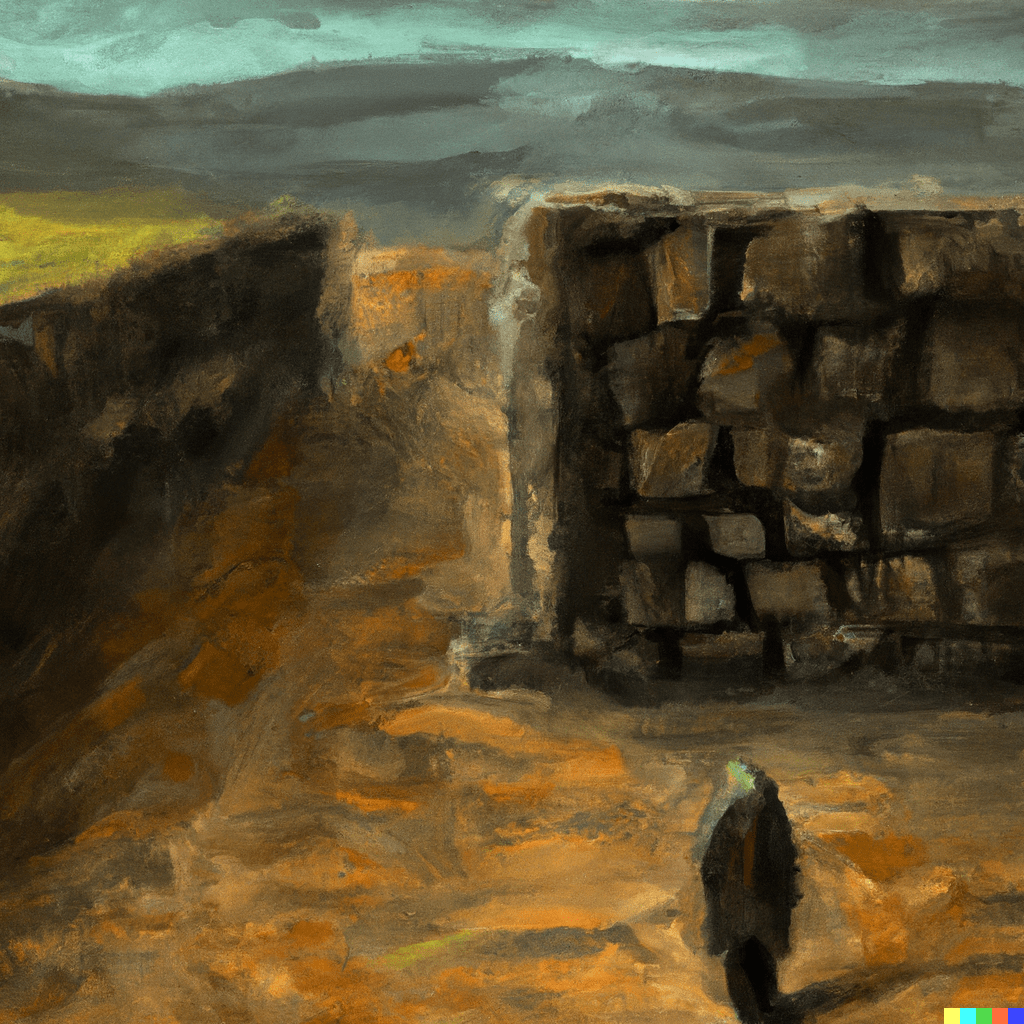
You might have some big barriers and walls in your way to accomplish what you would would like and what is right. In your relationships, maybe there is contention and incompatibility that seems insurmountable. In your goals, maybe you have bad habits that always seem to ruin your productivity. You might simply not have the right opportunities. You might not have enough time. You might feel like there is no way to make this work.
But sometimes instead of spending the effort to overcome those huge obstacles, you need to step around them instead.
It’s good to have a destination in mind. You need to determine what you really want: greater peace, greater love, unity, productivity, achieving certain goals.
But then realize that there might be a unique pathway to bet there that makes everything a lot easier.
It’s really hard change certain habits: but can you still achieve my goals with your bad habits intact? Maybe it’s okay to stay up late or watch movies or get distracted–how can you work around those thing instead of having to eliminate them?
It’s really hard to stop arguing with someone all the time: but can you still build up a loving relationship, even with those disagreements? Maybe it’s okay to fundamentally disagree about certain things–and instead look at what you have in common and build on that.
Sometimes you might have to adjust your end goal a bit, but you can still hold on to the things that really matter to you.
And when you have enough hope in that destination, that hope can help you see a way around obstacles that appear insurmountable. When you are determined to make things better, you can see different pathways that you didn’t notice before.
-
It felt like the right thing to do

This is how I make all of my major life decisions, and most of the minor ones too. Where I went to school. Who I married. When to have kids. When to go back to school. Where to live.
It just feels right, so I do it. I have reasons. I list out reasons, but I really don’t make measured decisions from a pro and con list at all. There are usually always reasons for and against, and it’s pretty much impossible for me to measure them properly. I can’t tell the future, after all.
Sometimes, I feel like I do things without ever making a decision at all. Why did I end up going to graduate school? It just sort of happened. I didn’t really make the decision when I applied, and yet I had already made the decision when I accepted. I have no idea when I made the decision. At some point, I just became accustomed to it.
But then again, I think I do know when I made that decision: there was a moment when I felt like going to graduate school is what God wanted me to do–that it was the right thing for me. It was a feeling, and I had to submit myself to that and let go of my own reasons.
I trust my feelings more than I trust my mind. My mind is often mixed up in indecision, but if I pay attention to what I feel, I can better know the right way forward.
-
Comparative Advantages and Inequality in Marriage

Marriage isn’t equal and fair. It’s not about two people doing 50% of the work so it all gets done.
In many ways, my husband is better than I am. He can have more energy, and can work longer and harder than I can (particularly in physical things). He remembers to rotate laundry and he can work a full day and then be home and still clean up and do dishes.
It’s easy to compare and measure myself against my spouse. Sometimes I come out ahead: I am doing all the planning and organizing and making sure that things no one really notices get done. Sometimes I come out behind: I can get super distracted and unfocused, and my energy runs out earlier than the day does.
But we both have our strengths and weaknesses, and instead of worrying about fairness and equality, we both just need to jump in there, put in 100% effort, and then try to smartly divide who is doing what.
In economics, there is this concept called comparative advantage. Simply put, just because one person is better at doing something than another person doesn’t mean that they need to do that thing all the time. There are opportunity costs too–if I’m better at doing housework, and spend all my time doing housework, than I don’t have the opportunity to go to school or spend time with my children. And even though I may be better at both housework and playing Yahtzee at my kids than my husband, it’s better if we divide and conquer a bit more cleverly. If he doesn’t love playing games, then it makes more sense if he does the dishes and I play Yahtzee (and I ignore the fact that I don’t like how he loads bowls into the dishwasher).
If he is better at fixing up cars and he’s better at home renovation, he doesn’t need to do all of that. I can work on the home renovation even if I’m not as good doing it as he does, because that gives him time to do things that I can’t even fathom how to do.
As I’ve gone back to school, we’ve had to shift over responsibilities for a while. I was feeling particularly exhausted and realized that I was placing a lot more burdens on my shoulders than I needed to. I did not need to be solely in charge of the house, the children, and all my schoolwork. Since I go to school every day and Dillon works from home, it made more sense to shuffle things around. He is now in charge of rotating laundry, cleaning the bathroom every other week, and cooking about half the meals. And I don’t have to feel guilty that I’m not doing everything.
It can be really hard to divide up responsibilities right, but instead of aiming for fairness, just aim for works best for you in the season of life you are in. Keep adjusting as needed. Keep expectations low and try the best you can. And if certain things don’t get done, that’s okay. No one knows the last time you washed your bedding or dusted your lights fixtures, and it’s okay if it’s been a while.
-
Uncertainty and Belief

We don’t know as much as we think we do. We are often mistaken and wrong and we need to rethink some of our beliefs a lot.
I’ve been reading and thinking a lot about uncertainty and correcting beliefs. But I also have been reading and thinking about commitment too. Sometimes we want to commit to beliefs, and hold to those beliefs, even when other people say we’re wrong.
I think it’s a miserable existence to only believe in what is supported with a proper meta-analysis and scientific consensus. Science can be great. But science is not the most important way we gain belief.
I believe there is truth, truth that is not relative. But I truth cannot always be discovered through the scientific process. There are many ways to discover truth, and to hold on to truth.
We learn through living. We learn through relationships and connection with others. We learn with experience. We learn sometimes through faith and action and seeing what works out and what doesn’t.
I want to be open to new beliefs, to updating what I think is wrong. But I am also committed to certain beliefs–beliefs on how to be a good person, how to raise my family, and how to live my life. Those aren’t the sort of beliefs I want to rethink over and over again. I just want to hold on to them and keep trying to live up to them.
I pray every morning and every night, and my prayer is often that God can guide me and that I can hear Him in my life. There are moments when I feel something that cannot be adequately explained except to say it is divine, that it comes from a power outside of myself. That is what I am committed to. That is what I believe.
So I will be a skeptic, sometimes, and I will be a scientist, sometimes, and then most of all, I will be a mother and a wife and a daughter and a friend, and my commitment to the most important beliefs will guide me to become an even better version of myself.

-
Tearing Down and Building Up

A professor in one of my classes told us that a philosophy paper gets lots of other people citing it when it is an easy target. Papers get cited not because they are good and authoritative, but because they are flawed, and then they get torn apart.
I have experienced this often in school: We read a paper. Not many people had nice things to say about the paper: It was quite faulty and not written perfectly. There are problems with the argument and examples and structure. The author cites too much or not enough.
In philosophy, unlike Theodore Roosevelt’s quote, maybe it is the critic who counts. I really like criticizing things sometimes. It feels powerful and fun. Like I’m better than someone else.
Sometimes I look on Reddit and comments on news articles and I am amazed at the loudness of all the critics who simply think that they are right and other people are wrong, so that entitles them to be mean and say whatever they want.
But I don’t like always tearing things down. I want to stop tearing things down. Start building something up instead.
Remember “constructive criticism”? When we criticize, we shouldn’t be doing it with the sole agenda of destruction. We should be building something up–making something better, working on improvement, or coming up with an alternative.
And if you want to destroy without building something up afterwards, then maybe it’s not worth it to tear that thing down. Maybe it’s best just to move on. So if it’s a really bad article, don’t read it or discuss it. If someone does something you don’t agree with, don’t pass judgment and complain about it with someone else.
Try to find good. Try to construct truth. Try to connect.

-
Graduate School
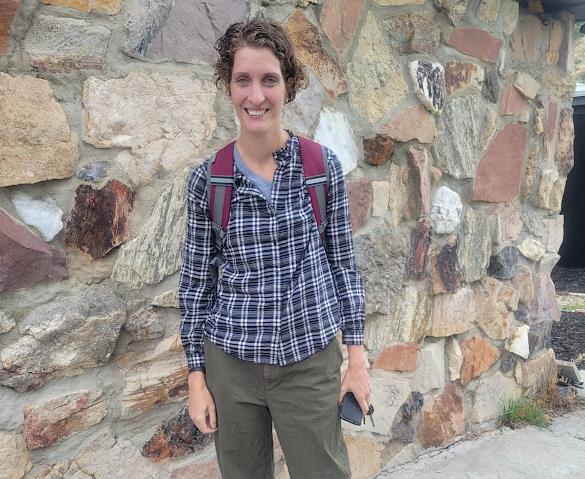
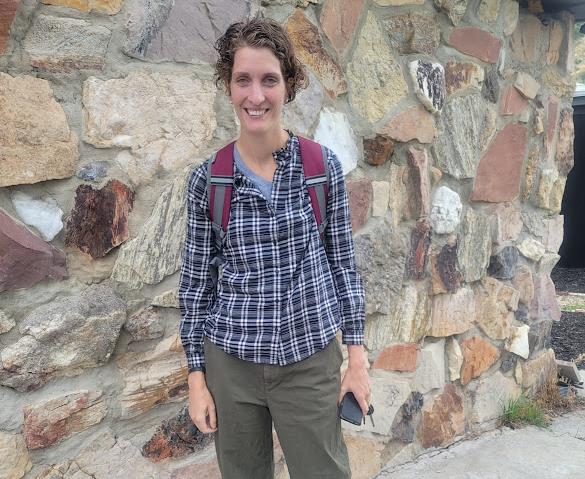
I have started graduate school. As I walk around campus, I look for people who are my age, and I don’t see many of them. Most people there are younger than me, and many are older than me as well. Sometimes I do feel a bit out of place–I know that there are graduate students my age, but I am settled in my life in a way that feels very unique: happily married, owning my own house, raising four kids.
Sometimes I feel a bit strange going to school. Unattached to my children, I somehow have transported myself to where I was 13 or 14 years ago, and yet I am not the same person. I think about them often, and I feel more alive and more of myself when I look to them.
But now I exist where people don’t know me as a mom of four children. By way of introduction, they want me to state my area of research, something that I am still figuring out. I’m not really figuring out what I want to study–I’m just figuring out the terms of how to categorize it. “Practical reason,” I finally decide to say, and then I add, “And economics,” just because it’s interesting. And I still very much like economics, and find myself slipping an economic term into a philosophy paper because different fields of study aren’t really that different after all.
There is always too much to learn, but I try to be a bit mindful of my time and my resources: I can’t go after every interesting idea and topic, but yet there are so many interesting ideas and topics.
It is a strange thing to tell people that you are getting a Ph.D., but in philosophy. As if the two things cancel each other out somehow. Smart, but completely unpractical. I get to spend years of my life writing things that no one will read, learning things that not many people care about.
But it fits me right now. And every time I learn, I want to maintain in the back of my head: how is this practical? Why would I care about it? Why would other people care about it? And hopefully, find some element of something useful and true in the sea of everything.
-
Changes
School starts tomorrow for most of my kids. I need to go fold laundry so that they can find what they want to wear, though I think they may have sorted through the laundry already.
This doesn’t feel that different: we just fall back into the old routine that we had a few months ago. I wake up at 6:30, get my daughter on the bus, come back and get the other kids ready.
But then something new happens. I’m going to school too now.
I am excited about it. I’m excited to connect with other people. To have time where I can exist outside of my home and my kids, and to be able to grow and learn, and then come home and share a bit with my children. They probably won’t ever care. My daughter said that all my books were boring and were about algebra or something. Philosophy isn’t math, and she sort of knows that, but she just categorizes everything she considers hard and boring together.
My daughter isn’t like me in some ways. She’s outgoing; I was very shy. She love cartwheels and handstands; I could never do one in my life. But we both love reading, even though she likes more adventuresome books than I do. I love watching her simply be herself.
I will come home every night after school to my somewhat unfinished home, to my children and my husband. I’ve never come home before like that. I’ve always just been home. And I think I’ll like coming home.
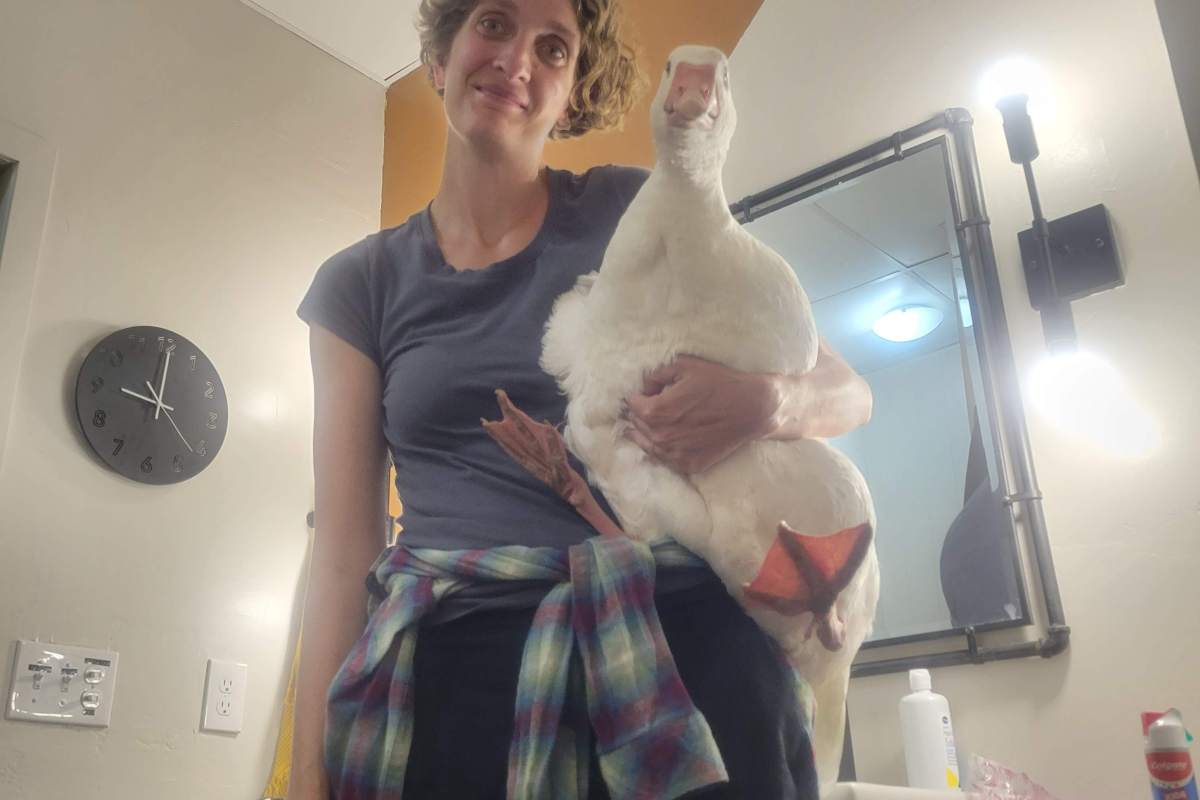
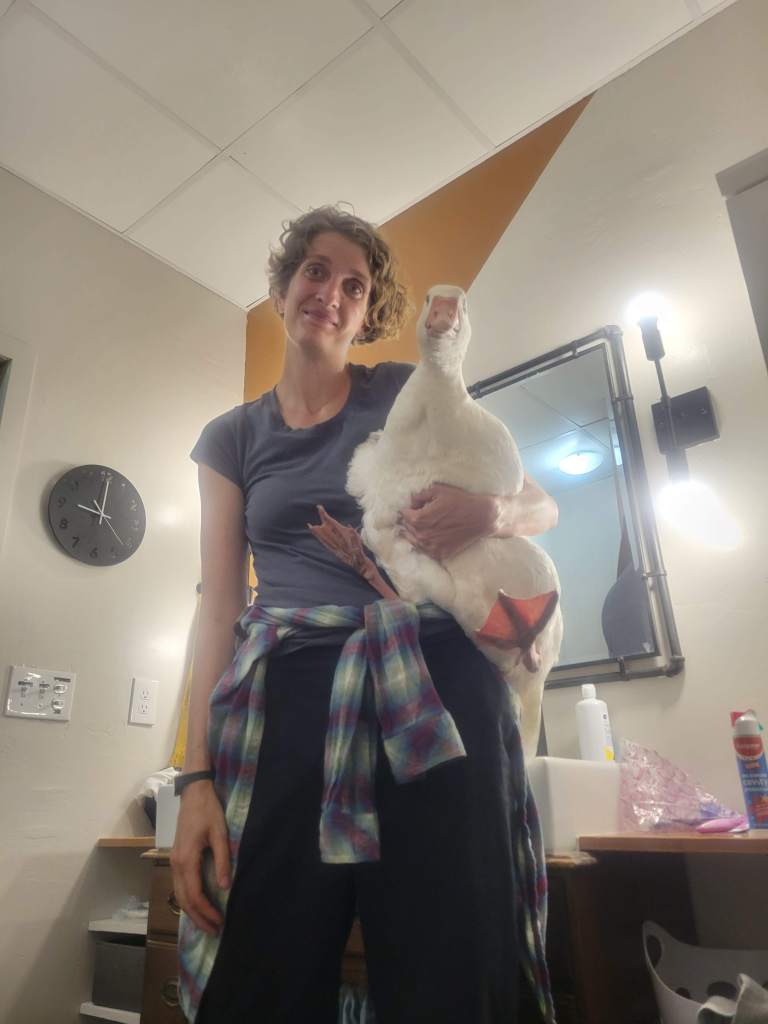
Also, I am including an interesting picture. It is of me holding a goose in a bathroom. I was on my computer in the evening and I looked up to see a goose staring back at me. We have a magnetic screen door, and Amelia figured out how to get inside. I had to pick her up and take her back out and shut the door, but she and Abigail still really wanted to come back in. The duck was in the pond, quacking and being sensible.
-
Some Thoughts

Editing sometimes focuses too much on the mistakes and weakness. I want to cross out everything I don’t like and reanalyze every word that doesn’t work quite right. But editing works better if I remember to look at what I’m doing well and build on that instead. The same often goes for life and relationships: instead of only seeing what could be better, look at what is doing really great and build on it.
There isn’t usually a best solution to difficult human problems. There are many solutions, some are somewhat better than others. Some sound crazy, but they would work. Some sound sensible, but they don’t work at all. Eventually, you just have to stop arguing and overanalyzing, try a solution out, see what happens, and then do something even better from what you’ve learned.
It’s easier to be successful in certain ways if a person has more wealth. Money can be used to pay for extra lessons, tutors, supplies, gear, or travel. It’s not fair, and it’s hard to compare when you don’t have the same advantages as someone else. But usually the success that money can buy isn’t the most important type of success anyway.

-
Subscribe
Subscribed
Already have a WordPress.com account? Log in now.
 Heather Hoyt