Quality and Quantity Time With Your Kids

In church one day, I heard a woman say that quality time mattered more than quantity time. My mom happened to be visiting, and whispered to me that quantity time definitely still mattered.

I was looking at a journal entry when I had little tiny kids, and I wrote that I found it very difficult to sit and entertain my two-year-old every day. I felt too much guilt because I couldn’t always make the quantity time into quality time. I’ve been a stay-at-home mom and a homeschooling mom, and for a white, I spent basically every moment of my life with my children. It was hard, and to be honest, I didn’t love it. But I still think it was valuable to be there, even if I wasn’t always enjoying myself.

Because often the quality times don’t happen unless there is quantity time first. I try to plan out quality family time, but it often implodes on me, and all I get is kids who complain because it wasn’t near as fun as we expected. But then quality time can sneak up when I least expect it. The other day, I discovered an impromptu dance party in my living room.

There isn’t a tradeoff between the two–they work together, and to maximize quality time, I maximize quantity time first. But I’m going back to school full time in the fall and I won’t be home as much. My kids will all be in school full-time. We also like running around to various sports and activities. How do we keep spending time together as a family?

First thing: turn off screen time and increase green time. The impromptu dance party only happened because it was a no screen day. Many studies show that screen time can have a negative impact on mental health and green time increased mental health outcomes. So going outside more, particularly as a family, is really beneficial for all of us.

Here are some other ideas:

  • If I’m not physically home, I can put up a camera that allows me to check on home and talk to those that are there.
  • I can write and leave notes for my kids.
  • I can wake up earlier and get ready before the kids are away so that I’m present before the kids go to school.
  • I can use the random minutes here and there. Car rides together. Late evenings. Intersections. Cooking dinner and doing dishes.
  • And I can involve my kids with what I am doing and what I am thinking.

And instead of looking only at days, I can look at weeks and months (I got this idea from Laura Vanderkam). I’m not maximizing time spent with my children on a daily basis; I’m maximizing it over weeks and months and years. I may not spend six hours with my kids every day, but I can spend three hours with them on the weekdays and 10 hours with them on the weekends. We can make up time with each other by going on vacation during summer break and using weekends for family time.

What are your ideas to maximize quantity and quality time with your kids?

3 steps to better use social media

Sometimes I waste a lot of time on social media. Honestly, it’s scary that these companies know so much about me and regularly use algorithms in order to steal and keep my attention. I know a few people who have deleted social media accounts, and I strongly support people doing that if they are only using social media to consume.

But social media can be a positive force in your life. Here’s how:

Create First.

Before you log on to social media, create something to share. It’s okay to just share a little bit about your life and what you are thinking. You can share a photo of your life or something you’ve seen that is beautiful. You can ask a question or do a short status update. You can also use Canva to make a social media post. I like to share quotes from books and articles I’ve read, my own blog posts, projects I’ve completed, and insight from my life.

You might think this takes a lot of time–but so does scrolling through social media! If you don’t have time to create a post, you probably don’t have time to be on social media in the first place.

And don’t worry if your posts are good or not. Just make them. Try things out and experiment. Your friends want to hear from you, not just from influencers and commercial creators.

Again, let me stress that you do this before you go on to social media. If you go onto social media first, you will be too distracted to create something.

Connect Second.

After you post something, spend time connecting with other people. This is not just looking at posts. It means interacting with posts: Share them (and say why you are sharing). Comment on them. Answer questions. You won’t want to interact with every post you see, but try to find something that resonates with you and then respond to it. If nothing is inspiring you in your feed, than change your feed–unfollow people who don’t bring you joy. And send personal messages to people you know and love.

Set limits to resist consuming.

I don’t have social media on my phone. Sometimes I will install Instagram to make a post or a story, but then I often uninstall it. And I use two apps with time limits on them: Digital Wellbeing (which is standard on Android) and YourHour. On my computer, I use FocusMe. But there are lots of other apps and programs to use. You don’t have enough willpower to not waste time on social media. Social media is designed to suck away your time, so you need backup to tell you when you need to look up and do something else.

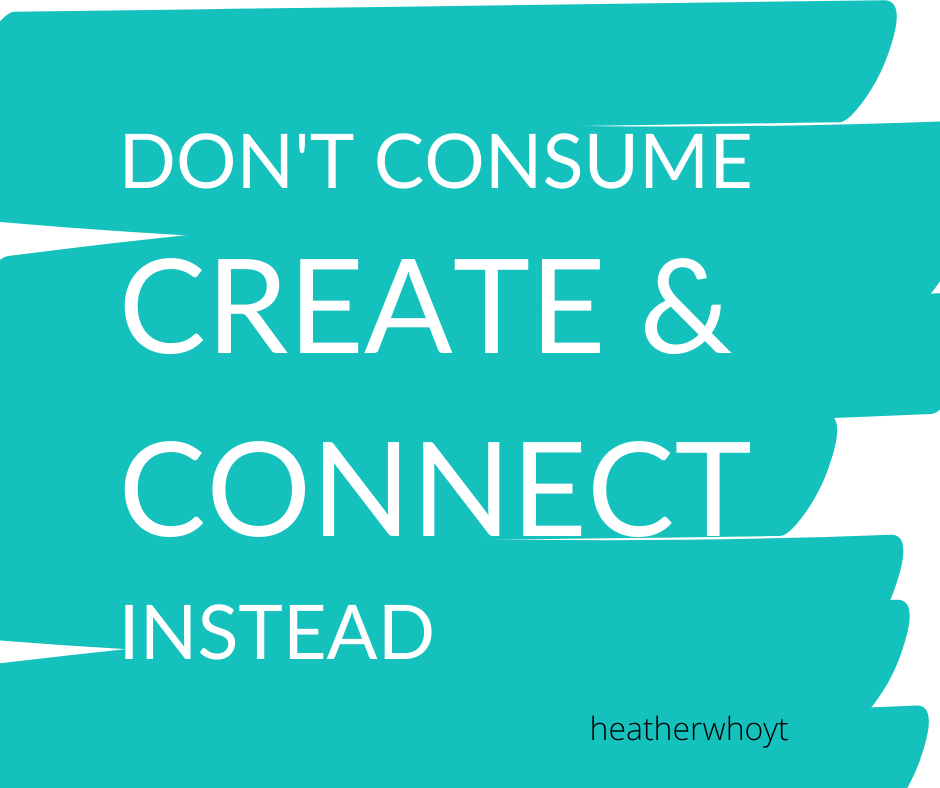
Create and connect instead of consume. Social media can be a good force in your life–and if it isn’t, get rid of it.

On Confidence and Humility

Confidence and humility are not opposites: they are the same thing.

When I am feeling proud, I want to be better than everyone else. I want to pull people down in order to lift myself up. I can place a lot enmity between myself and other people: Sometimes I want what another person has. Sometimes I compare myself to others. I think I’m better than I really am. This brings a huge amount of insecurity, because I’m not actually better than everyone else. I am imperfect, and the work I do is imperfect.

I can’t be confident when I really want to be the best at something. Because I’ll never be the best, so I’ll drown in insecurities.

When I am more humble, on the other hand, I recognize that other people have a lot of worth. I can learn from them. I want to celebrate their accomplishments and support them. I’m looking outwards and seeking to connect instead of compare.

When I am humble, I am okay when I don’t know the answers. I am aware that I can always keep improving. And I want to improve more, because I see my capacity for growth.

In humility, I find confidence. Because confidence is when you are okay with being bad at something.

Confidence is when you are okay with being bad at something.

Think about going and talking in front of a group: if you are worried about having every word right, you are going to be terrified, because you know that it is very likely you will get some words wrong. But if you know you’re going to stumble sometimes, and say “um” way too much, and that you’re going to press onward no matter what, then you can walk up to the front of the group with confidence. You are confidence not that you will be perfect, but that whatever you attempt is good enough.

Don’t worry about confidence: it will come once you are comfortable making mistakes. And you become more comfortable with making mistakes when you increase in humility.

We all make mistakes. But we keep trying anyway.

Another post about humility. And another.

The Right Time

In 2018, I put a book I had written (One Thing is Needful) in a figurative drawer and thought I would never look at again. But in 2020, I got it out again and started working on it. Two years later, I’ve basically finished it. I’m working on sharing it more soon.

I try to follow the Lord’s will about when to do things. Sometimes I do the right thing, but it’s not the right time yet. Sometimes it takes me a whole lot longer than I want it to.

In the end of 2018, I moved to this home in the mountains and I thought I would live here for forever. But I didn’t stay more than a few months, and when I moved away, I thought I would never come back. A year later, at the end of 2019, we owned this house and it’s been my home for almost two years now.

I really worked to get a novel published before I had kids, but it didn’t work out. I thought I wasn’t good enough to be a writer and that I failed. But years later, I went to a conference, surrounded by authors and people trying to write, and I realized that I didn’t fail because I wasn’t good enough. I failed because it wasn’t the right time for me yet, and I had more things to learn.

The right people will be in your life at the right time. I have felt very much alone and I thought no one was there–but those times forced me to reach out to people who needed me. And then people came when I needed them to. I was led to people who I needed to connect with. I learned from others when I needed to learn those things.

I still don’t know the timetable for many things in my life. Some things will be a lot slower than I want them to be. Some things might happen a lot quicker.

But if I trust in the Lord, I can do His will.

And His will is much more about becoming the person I need to be than just getting things done.

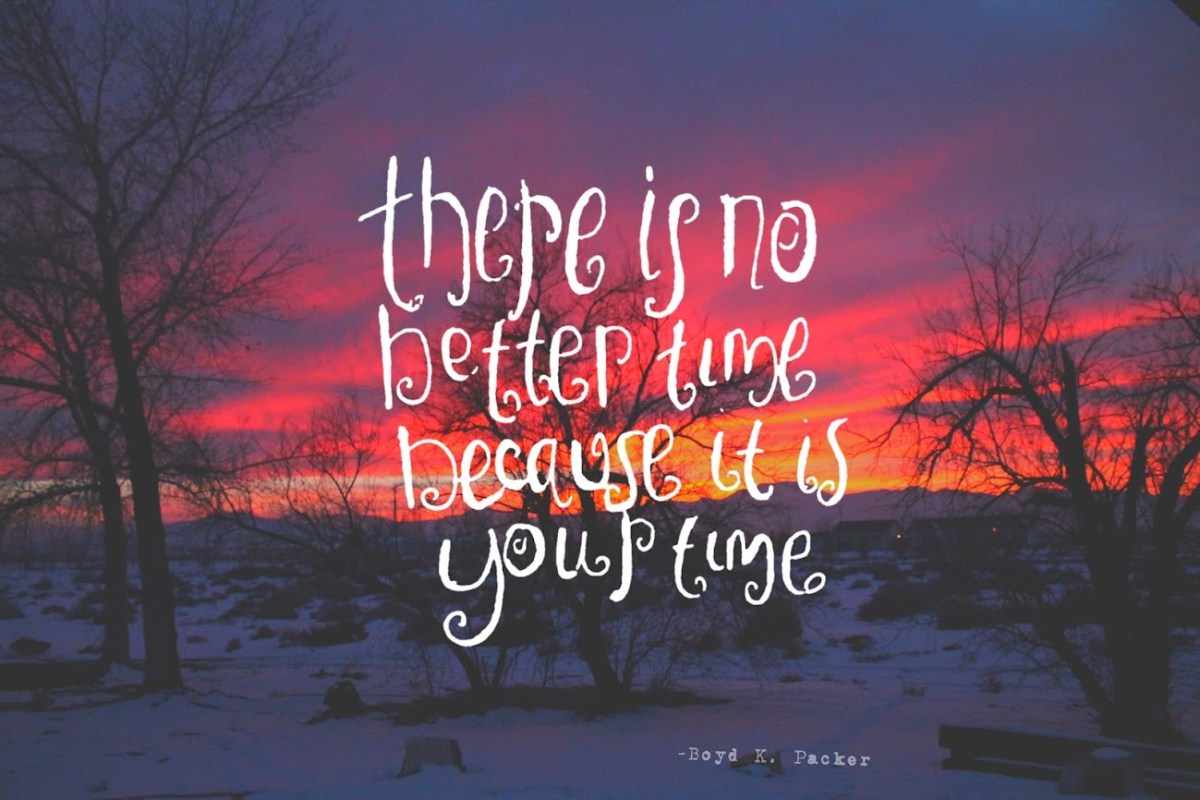
There is no better time because it is your time. -Boyd K. Packer

Running as fast as I can

Kids running GIF

I don’t like to run. I did track in junior high, and my best event was the 400 meter, which is a horrible event. You have to run fast and long. (It is slightly better than the 800 meter.) I wasn’t fast. And I don’t like going on long runs. The longest I have ever run is a 5k, and I did that once.

But I do like to pile things onto my to-do list. I want to work on everything now. My current projects include finishing my inspirational self-help book, writing a new novel, writing a new inspirational self-help book, leading a writing group in my community, beta reading for another writer, building up my Instagram account, doing a writing workshop, and updating my blog. That’s just writing stuff. Then I am working to finish the Khan Academy calculus bc course, keep learning how to code in R better, and read nonfiction in the areas of rationality, philosophy, and economics, including finish reading that macroeconomic textbook because I didn’t do well in macroeconomics in college and it bothers me. I am also renovating a house, and today I painted the laundry room walls and flooring, and I need to put that room back together. I need to mud and tape my whole house and paint it. And I need to prune my apple tree and work on my yard, including taking care of my birds. I am trying to be a good neighbor and want to go visit others more. I volunteer at the school. And I need to keep my house clean, which includes dusting on occasion and doing a lot of laundry. I also am trying to touch my toes, do more push-ups, and drink 64 ounces of water every day.

And I want to be a good mom, pay attention to my kids, teach them piano, and read with them. And I have a husband whom I really like.

It’s sort of a lot. But not really. Because I don’t have to do all of that at once. I can only do one thing at a time, after all.

Sometimes I need to simplify and slow down. But that doesn’t mean I need to give up on my goals–a lot of them can be pushed to later. I can prioritize by realizing what season of life I am in right now, and then being patient with myself when I can’t do everything right now, but I can do everything over time.

Do not run faster or labor more than you have strength and means provided to enable you … but be diligent unto the end.

Doctrine and Covenants 10:4

I don’t need to remove things from my to do list for forever. Just for right now. I want to pace myself by not trying to do everything every day, but just a few most important things every day.

Today, I’m not worrying about my novel, or my writing workshop, or reading my macroeconomics textbook. Those things can happen later. Today, I am focusing on working on my laundry room, finishing the draft of my inspirational self-help book, and taking care of my kids, one of whom has pink eye, and another one who threw up last night (but he’s fine now). I’m writing this blog post as they happily play with Duplos.

In the evening, I’m going to watch one of my favorite TV shows with my husband and work on the Semantle and Nerdle puzzles for the day, because I don’t need to be productive all the time. But hopefully things like entertainment and spending time doing nothing on my computer can be minimal: because while I want to avoid running too fast, I do want to keep running instead of getting distracted and forgetting what direction I’m heading.

Where are you running to? Are you going too fast? Do you need to pick up the pace a bit? What can be put off until later and what needs to happen right now?

Elephant on my brain

I hate the fact that I deal with mental health struggles. I want to just be fine. I want my brain to work well every day. And sometimes it does. Sometimes we really get along, and my brain can make decisions and respond appropriately and think clearly and regulate my emotions.

But sometimes there is an elephant on my brain. It’s like my brain is squished up and heavy and no longer works quite right. I feel out of control and I find myself doing things that I know aren’t rational. I will yell and scream over things that aren’t a big deal. My brain will circle around in the same, irrational thought patterns as another part of my brain yells to stop thinking like that.

I have a hard time regulating everything. I’ll go deeper down rabbit holes. I’ll lose track of time. I have a hard time focusing. I lose interest in everything. And sometimes, I feel like I’m disconnected with reality, as if I exist a little bit separate from it. Something is wrong and I doubt my own sanity. I know I’m not okay but I just want to be okay.

I want to label it as depression, PMDD, anxiety, ADHD, bipolar–any label will do, really, and then by labeling it I can throw medication at it and make it go away.

I have my tool box of mental health tools that I can use: Go outside. Exercise. Eat food. Drink water. Practice meditation. Do grounding techniques. Write. Get enough sleep. Cognitive restructuring and talking back to negative thoughts. Talk to other people. Routines. And medication does help.

I try. But sometimes, no matter what I do, I’m not okay. And that is okay. Because I will come out of it, especially when I keep using my techniques and tools the best that I can.

The elephant will move away. I’ll wake up and feel all of that weight off of me. Things will go back to normal.

I keep trying the best that I can. And that is enough. I’ll be smiling again soon.

Heather W. Hoyt

63. Is the pursuit of money worthwhile?

Here is the very unfair thing about money: If you have money, it’s easy to gain more. If you don’t have any, it’s hard to gain any.

I recently read John Green’s essay about Monopoly from The Anthropocene Reviewed. He talks about the unfairness of Monopoly and how it relates to the unfairness of life. Once you have Monopolies, you just get richer and richer until you push people out of the game.

And once you get rich in real life, it’s really easy to get richer and richer. When you have enough capital, you start investing that, and you get more capital to invest even more.

When you have a really good resume, you can leave one high-paying job and get an even more high-paying job.

And when you haven’t been making money and you don’t have very much money in your bank account, it’s really hard to get started.

In our recent house renovations, we have drained out our savings of the last 10 years as we’ve poured our time and resources into our home. It gets a bit stressful sometimes as we try to avoid debt (though we have a home equity line of credit as a contingency).

Most people would like more money, even if it wouldn’t necessarily make them happier.

I have a hard time pursuing after extra money; it’s just not a great motivator for me. But for some people, they spend their whole lives trying to get more and more.

But money is only good as a means to an end, not an end itself.

So why are you pursuing money? To live a richer life? To help others? To worry and stress less? To save up for large projects? To provide for your family?

The reasons matter.

9. Why are the important things in life fleeting and the unimportant things so time consuming?

I’ve been attempting to track my time lately, and in this attempt, I’ve noticed that moments that matter can take a very small portion of my life.

In 10 minutes, I can do something significant: help my children, connect with my spouse, or complete a project that has been on my to-do list for ages. I can say hi to a neighbor, read scriptures, and pick up the house. I can meditate, pray, or exercise.

But then I get stuck trying to buy home insurance or I sort through emails or go shopping or try to find the answer to a simple question on the internet. I can get lost for hours, and at the end of it, I’m not happy with how I spend my time.

There is something named the Pareto Principle that says that 80% of the consequences come from 20% of of the causes.

If I apply that to my life, 20% of what I do has meaningful results, and 80% of what I do doesn’t really matter. And that seems sort of accurate to me.

Is there a way around this? To have more of my actions be meaningful? Or do I just try to keep working the best I can, and try to savor the meaningful moments when they come?

(Photo by Austin Distel on Unsplash)

Honesty: How to Fix Your Life

Honesty can solve a whole lot of problems.

tree peeling off sign honesty

I always thought I was a very honest person: I never told lies or cheated or tried to steal anything, so I was good.

But here’s the thing: I still very much care what other people think about me, and sometimes dishonesty creeps in as I fail to admit my shortcomings and mistakes, both to myself and to others. Admitting what I do wrong has been my biggest struggle with honesty. I want to be an awesome person that doesn’t make many mistakes. But I am not: I yell at my kids, I pick my nose, I get discouraged, I waste time, and I support political candidates without knowing much about them.

My lies are plentiful: I want to hide things from the building inspector. I pretend that I heard someone speaking when I wasn’t paying attention at all. I tell a friend I’m doing fine and everything is great when it really isn’t.  When I don’t know something, I fabricate information. And at the store, when my kid breaks the top off a bottle of soap, I stick it on a random shelf and walk away.

Some of these may be trivial. But when dishonesty starts to creep up in small ways, it becomes a lazy way to deal with hard things. Dishonesty just pretends that those hard things don’t exist.

But honesty is when I have to face life as it actually is, giving up my idealized version of reality.

So how can honesty solve life’s problems if it seemingly makes life harder? Because denying the truth doesn’t make the truth go away, and when I face the truth, then I free myself.

Honesty can help solve depression.

Almost all depressing thoughts are lies.

LIES: I am not worth anything. No one likes me. Life is too hard. I can’t do this anymore.

TRUTH: I am worthwhile. Lots of people like me. Life isn’t too hard (what does that even mean, anyway?). I can do it, and I will do it.

Honesty can solve anxiety.

Anxious thoughts are lies.

LIES: This will never go away. People are looking at me and judging me. Bad things are always happening everywhere. I’m stuck here forever.

TRUTH: Everything does go away. People are often too caught up in themselves to notice others very much. Good things happen just as much as bad things.

Honesty can solve parenting difficulties.

I lie so often to my children, and they respond a lot better if I just tell them the truth.

LIES: Clean your room or else. I will take that away in five seconds. If you do not do better, I will punish you. You are so difficult. Because I said so and that’s all that matters.

TRUTH: I love you. I’m proud of you. This is really hard for me right now. I don’t want to yell. I make a lot of mistakes. The house is messy. I don’t want to clean it alone.

Honesty can solve problems at school or at work. 

LIES: I don’t have any questions. I understand everything. Sure, I can do that. I haven’t done anything wrong.

TRUTH: I have so many questions. I don’t understand what is happening. I’m not sure I can do that, but I can try. I messed up and I will try to make it better.

And honesty can help solve everything else. 

Do you have a job interview? Just be completely honest and then there is no reason to be nervous.

Did you make a big mistake that’s keeping you up at night? Just admit what you did wrong and ask for help.

Do you have unpopular opinions? Don’t make excuses. Stand up for what you believe is right.

Are you angry with someone for some reason? Talk with them and see if you can calmly work it out.

Want to improve your relationships? Stop gossipping, tell the truth about others, and tell the truth about yourself. Be vulnerable.

Truths

There are a few truths that can get you through extremely difficult times:

  • First, that you are always worth something.
  • Second, that everyone, including you, makes mistakes.
  • Third, that so much of life, including mistakes, is temporary.

When you face truth, you can find peace by releasing the expectation of perfection and finding true meaning in life as it actually is.

Further reading:

Challenge the voices you hear

I read a few articles lately about people leaving their 9-to-5 jobs in order to live the life of their dreams. And it sounds like a good story. It makes me question for a minute: would I be happy if we were financially independent and self-employed in some creative task?

I think the answer is no. I enjoy having my husband’s predictable income, sending him to work five days a week, and having the safety of good benefits.

Some people like to take risks, but I don’t enjoy it much. I’m not afraid of it and I’m not limiting myself through my fear; I just prefer stability. It’s like when I go to a theme park and I feel pressured to ride the intense ride. Sometimes I do. And it’s okay, but I don’t enjoy it enough to actually pay money to go get motion sick.

I always wanted to be a writer, but in my adult life, I realized that I despise promoting myself. Which means that I would also hate being a successful writer.

I get caught up in what other people think is successful. It might be nice to go to nice schools and get high-paying jobs. It might be nice to travel all over the world. It might be nice to get a homestead and work from home. But just because someone else loves their life doesn’t mean I would love their life.

I have to be careful: I asked myself the other day if I wanted to pursue graduate school because I actually wanted to be in that environment or because I felt it would be prestigious. Did I want to tell other people I had a specific degree, or did I really want to actually get that degree?

I really enjoyed working as a legal secretary, even though it was a low-paying job that didn’t require many qualifications. I have to look at myself and what I want to do instead of just copying someone else’s success.

Being true to yourself sometimes that means abandoning dreams. Sometimes that means being completely normal and boring and eating vanilla ice cream because you like vanilla.

There are things that I know about myself: Money does not motivate me. I never want to be famous. I don’t enjoy taking huge risks. I like working on computers. I like spreadsheets and math and paperwork. I like being told what to do. I like teaching and I like creating as well.

Ultimately, I want to live in a way that helps other people in small and simple ways.

If that means my life is boring, then I’ll live a boring life.